Applying for a Chinese visa is the essential first step for most travelers looking to explore the Middle Kingdom. Since late 2024, the process has transitioned globally to a streamlined online system, making it more convenient than ever. This comprehensive guide will walk you through the entire process, from determining if you need a visa to successfully receiving one in your passport.
Part 1: First, Do You Need a Visa?
Before you begin, check if you are exempt. China has visa waiver agreements with certain countries and offers transit-without-visa (TWOV) policies at specific ports for travelers with confirmed onward tickets within 24, 72, or 144 hours. Additionally, some nationals may benefit from unilateral visa-free policies. If your travel does not meet these conditions, you will need to apply for a visa.
Part 2: Understanding Your Visa Type (Choose Wisely)
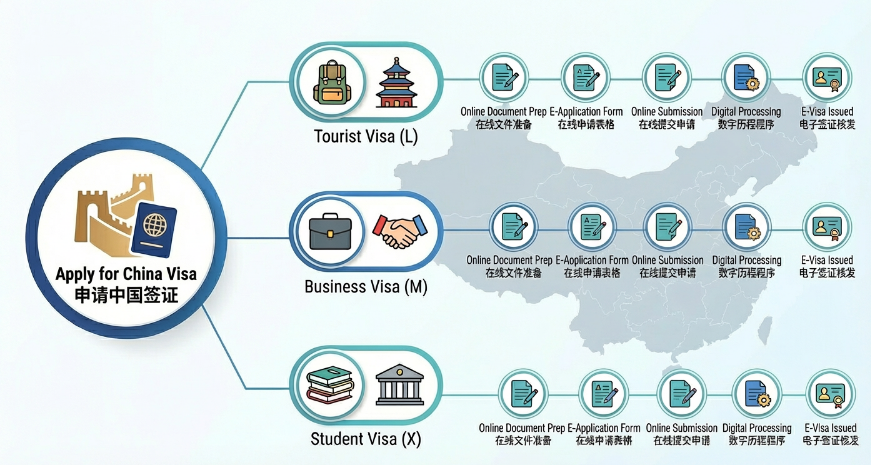
Selecting the correct visa category based on your purpose of travel is crucial. Applying for the wrong type is a common reason for delays or refusal. The table below outlines the most common visa types for visitors.
| Visa Category | Letter Code | Who Should Apply | Key Supporting Document(s) |
| Tourism | L | For sightseeing and leisure travel. | Round-trip flight bookings and hotel reservations, |
| Business & Trade | M | For commercial visits, trade fairs (e.g., Canton Fair), or market research. | Invitation letter from a Chinese trade partner or business entity. |
| Non-Commercial Visit | F | For exchanges, visits, research, or lectures. | Invitation letter from a relevant Chinese organization. |
| Family Visit | Q1 / Q2 | For visiting family. Q1 is for long-term stays (>180 days), Q2 for short-term (≤180 days). | Invitation letter from a Chinese relative, proof of family relationship (e.g., marriage/birth certificate), and inviter's ID. |
| Private Visit | S1 / S2 | For visiting foreign friends/relatives working/studying in China. S1 for long-term, S2 for short-term. | Invitation letter, the inviter's passport and Chinese residence permit, and relationship proof. |
| Student | X1 / X2 | For academic study. X1 for long-term (>180 days), X2 for short-term (e.g., language courses). | Admission Notice from the school and a |
| Work | Z | For employment in China. | Official |
| Transit | G | For transiting through China to a third country/region. | Onward ticket with confirmed date and seat to the final destination. |
Part 3: The 7-Step Application Roadmap
The modern application process consists of online and in-person stages. Follow these steps in order.
Step 1: Preparation – Gather Your Documents
Before going online, prepare digital copies (clear scans or photos) of these core materials:
- Passport: Must be valid for at least 6 months beyond your application date and have blank visa pages.
- Recent Photo: A front-facing, color, bareheaded photo on a plain white background.
- Supporting Documents: As required for your visa type (see table above).
- Proof of Legal Residence: If applying outside your home country, provide evidence of your legal status there (e.g., visa, residence card).
Step 2: Access the Online Application System
Crucially, identify the correct website for your location:
- Option A (Most common): Go to the central Chinese Visa Online Application system at **https://consular.mfa.gov.cn/VISA/.
- Option B (For some countries): You may be directed to a localized Visa Application Service Center (VASC) website, often **https://www.visaforchina.cn/, where you must first select your country and city.
Step 3: Register, Fill & Submit the Online Form
- 1. Register: Create an account using your personal email address.
- 2. Fill the Form: The online form has **9 sections**. Be meticulous. You must provide detailed work and education history for the past 5 years, using full company/school names (no abbreviations). Travel dates must be within the next 90 days. The system allows you to save a draft.
- 3. Upload & Submit: Upload digital copies of all your prepared documents. Documents marked with a red border are mandatory. Review everything carefully before final submission, as you cannot edit the form afterward.
Step 4: Wait for the Initial Online Review
After submission, the embassy/consulate will conduct an online review. This typically takes **1-5 business days**. Monitor your application status online. If the status becomes "To be modified" follow the instructions to correct or supplement your materials immediately.
Step 5: Submit Your Passport In-Person
When your online status shows "待递交护照" (Pending Passport Submission) or similar, you must submit your physical passport.
- Who Must Go? Most applicants must appear in person to **provide fingerprints**. However, you are exempt if you are under 14 or over 70, or if you are applying for a **single/double-entry short-term visa (stay ≤180 days) before December 31, 2025.
- Who Can Send Someone? If you meet the fingerprint exemption criteria, you can authorize another person or an agency to submit your passport for you.
- Bring: Your passport, the printed application form/confirmation page, and any original documents specified in the requirements (e.g., original invitation letters for certain visas).
Step 6: Pay the Visa Fee
Payment is made at the time of in-person submission (online payment is generally not available). Fees vary based on your nationality, visa type, and number of entries. Always check the specific fee schedule on the website of the office where you are applying.
Step 7: Collect Your Passport
After final processing, collect your passport with the visa affixed inside. You or your authorized representative can do this, usually by presenting the payment receipt and pick-up slip.
- Standard Processing: Typically 4 business days after passport submission.
- Expedited Service: Often available (e.g., 2-3 business days) for an additional fee.
Part 4: Crucial Reminders for a Smooth Application
- Online System is Mandatory: The online application is now required for almost all applicants. Paper forms are generally no longer accepted.
- Accuracy is Everything: Inconsistencies between your application, documents, and verbal statements can lead to refusal. All information provided must be true and complete.
- Consult Your Local Office: While this guide outlines the universal process, always double-check the website of the Chinese embassy, consulate, or VASC that has jurisdiction over your place of residence for any country-specific requirements or procedural nuances.
- Final Entry Requirement: Remember that from **November 20, 2025, all foreign visitors must also complete an online Arrival Card before entering China.
By following this structured guide and paying close attention to detail, you can navigate the China visa application process confidently. The key is to start early, prepare thoroughly, and ensure every piece of information aligns perfectly with your purpose of visit. Good luck, and we wish you a fantastic journey to China