Silence in the Heart of the Chaos: A Morning at the Sun Yat-sen Memorial Hall
Guangzhou is a city of noise. It is a cacophony of car horns, construction drills, and shouting vendors. But there is an eye to every storm, and in Guangzhou, that eye is blue.
I walked to the Sun Yat-sen Memorial Hall on a humid Thursday morning. The city was already awake and screaming, but the moment I stepped through the gates, the volume dial turned down.
The Ancient Sentinels
The first thing that greets you isn't the building; it’s the trees. The grounds are dominated by ancient Kapok trees and massive banyans. I stopped under a banyan tree that looked like it had been growing since the dawn of time, its aerial roots hanging down like the beards of wise old men.
A red flower from a Kapok tree had fallen onto the path. I picked it up. It was heavy, waxy, and vibrant—the "Hero Tree," as locals call it. Holding it, I looked up at the hall.
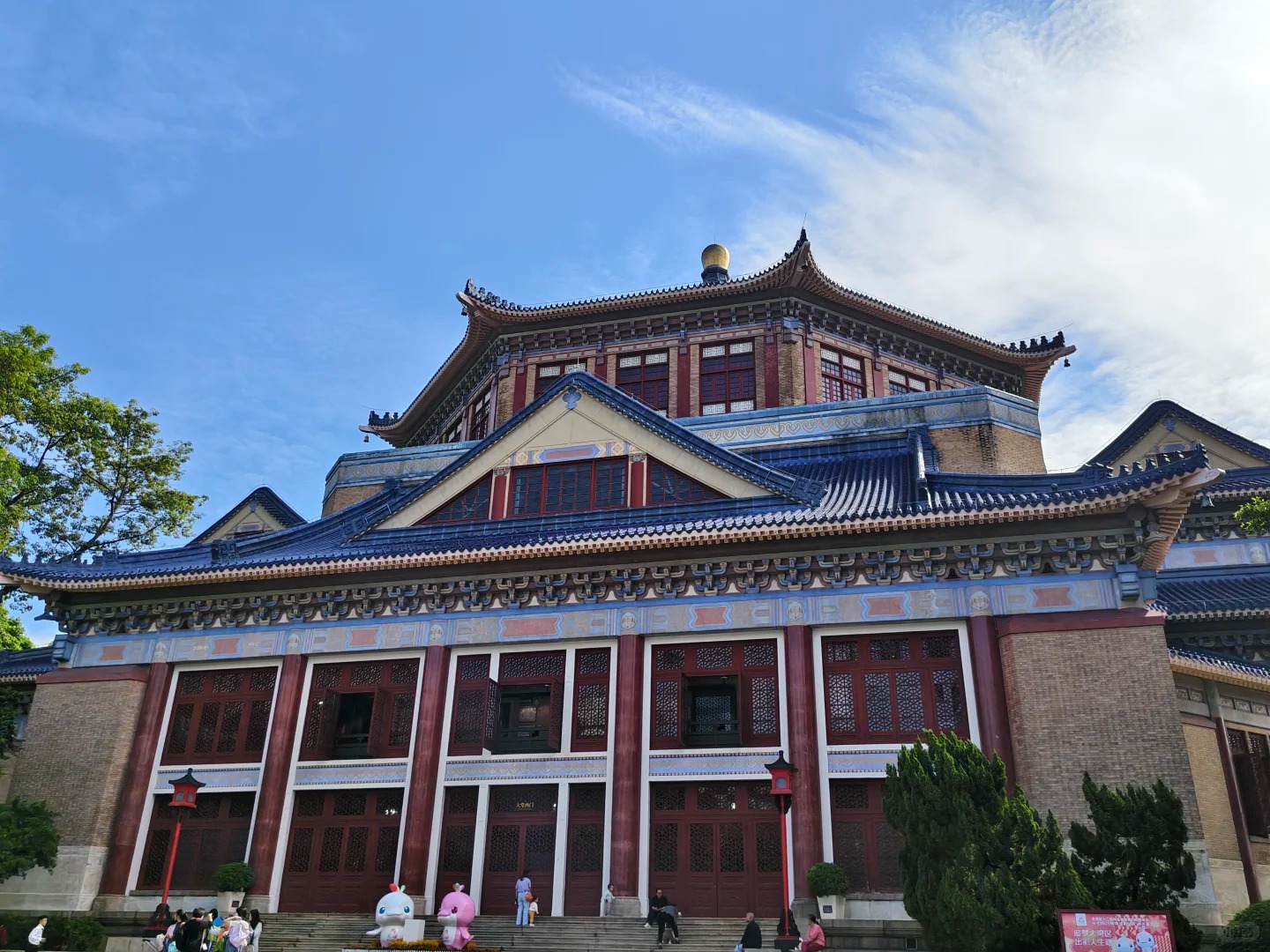
It’s an architectural paradox. It looks traditionally Chinese, with its octagonal shape and flying eaves, but it’s built with modern steel and concrete. The roof is what catches you—a deep, regal sapphire blue. Not the imperial yellow of Beijing, but a democratic blue. It felt cool just looking at it.
The Space Without Pillars
I bought my ticket and walked inside.
I’ve been in many grand halls—cathedrals in Europe, temples in Kyoto. Usually, your eyes are drawn to the pillars that hold the roof up. But here? There are no pillars.
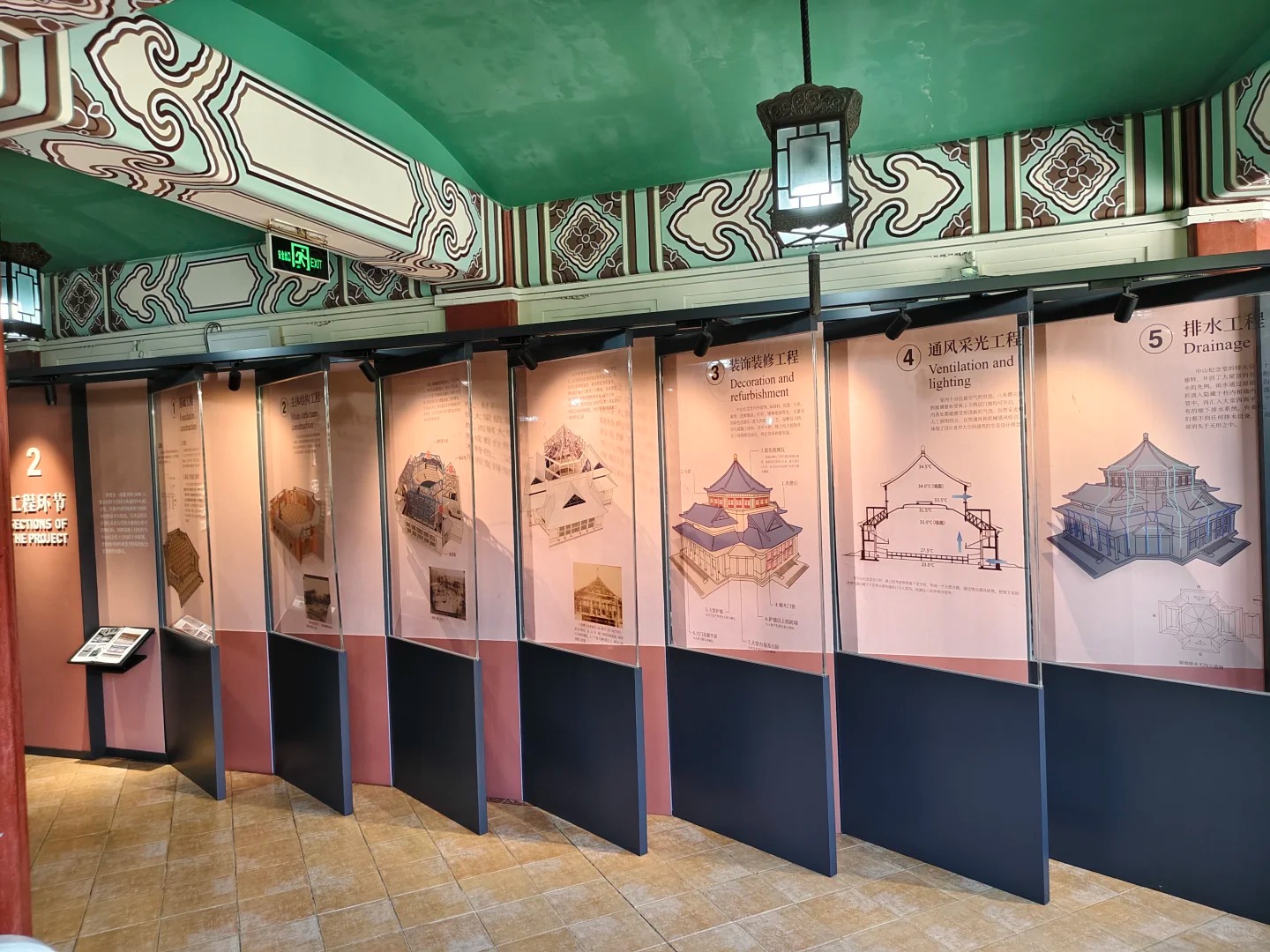
I stood in the center of the auditorium and spun around slowly. The space is vast, spanning 71 meters, yet there isn't a single column blocking the view. It’s an engineering magic trick from 1931. The architect, Lu Yanzhi, used hidden steel trusses to suspend the massive roof.
It creates a feeling of total openness. I sat in one of the wooden seats in the back row. It was quiet inside, a respectful, dusty silence. I closed my eyes and tried to imagine the voice of Dr. Sun Yat-sen echoing in this space. The air felt heavy, not with humidity, but with history. You could feel the weight of the "Three Principles of the People" soaking into the walls. It wasn't just a building; it was a physical manifestation of a dream for a new China.
The Kite and the Grandfather
I spent an hour inside, reading the history exhibits, looking at the faded photographs of grim-faced revolutionaries. But the most profound moment happened when I walked back out into the sunshine.
In the square in front of the hall, an old man was flying a kite. It was a simple thing, shaped like a swallow. He was adept, twitching the string with small, precise movements of his wrist.
I watched the kite rise. It went up, higher and higher, until it was hovering right next to the blue tiles of the Memorial Hall’s roof.
The contrast struck me. Below, the heavy, solemn history of the revolution. Above, a fragile paper bird dancing in the wind. The old man noticed me watching him. He grinned, revealing a gap in his teeth.
"High, isn't it?" he asked in Cantonese.
"Very high," I replied.
He handed me the spool. "You try."
I took the string. I could feel the wind tugging at it, a live wire connecting me to the sky. Standing there, in the shadow of the great blue hall, flying a kite with a stranger, I felt a sudden surge of affection for this city.
The Living Monument
Travel guides will tell you about the dimensions of the hall, the number of seats, the construction materials. But they won't tell you about the peace.
The Sun Yat-sen Memorial Hall isn't a tomb. It’s a living space. It’s where grandmothers practice sword dancing in the morning, where couples take wedding photos in the afternoon, and where history serves as a backdrop for the simple joy of flying a kite.
I handed the spool back to the grandfather and thanked him. As I walked away, I looked back. The blue roof was gleaming against the grey sky, unshakeable and calm. I left the silence behind and stepped back into the noise of Guangzhou, but I carried a little bit of that blue peace with me.