They say China is not just a country, but a world unto itself. Before I arrived, I had read the guidebooks and seen the documentaries. I thought I knew what to expect. But standing there, feeling the pulse of a billion lives and thousands of years of history, I realized I knew nothing. This wasn't just sightseeing; it was a collision with a civilization that felt both impossibly ancient and aggressively modern.
If you are asking yourself "Where should I go in China?", let me take you by the hand. Forget the sterile lists of "Top 10 Spots." Instead, let me share the China I found—the one that smells of roasting chestnuts in winter and wet bamboo in summer, the one that sounds like temple bells mixed with the hum of electric scooters.
Here are the pages from my diary, a testament to a journey that changed the way I see the world.
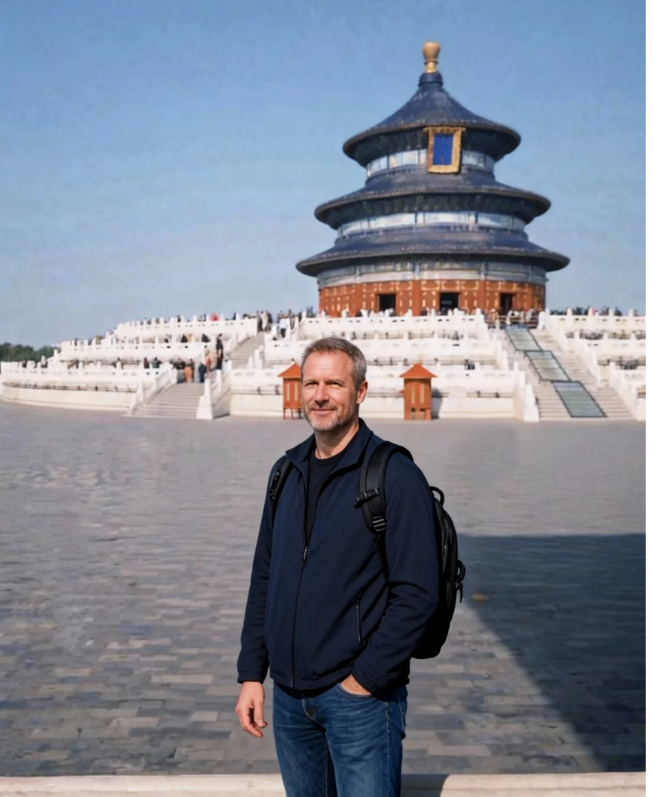
Beijing: Whispers in the Alleyways and Stones of Giants
My journey began in the capital, Beijing. I arrived expecting a concrete jungle of politics and power, but what I found was a city of profound duality.
On my second morning, I woke up before dawn to visit the Great Wall at Mutianyu. Everyone tells you it’s big, but "big" is a lazy word. It is endless. I remember the burn in my calves as I climbed the steep, uneven steps. The air was crisp, biting at my cheeks. When I finally reached a watchtower and looked out, the silence was heavy. The stone dragon snaked over the mountain ridges, disappearing into the mist as it had for centuries. I ran my hand over the rough grey bricks. Soldiers stood here once, shivering in the wind, watching the horizon for smoke. Standing there alone, I felt very small, a fleeting moment in the timeline of these mountains.
But the real soul of Beijing wasn’t on the peaks; it was in the Hutongs.
One afternoon, I abandoned my map and wandered into the maze of these grey-brick alleyways near the Drum Tower. The skyscrapers of the CBD vanished. Here, life was intimate. I saw an old man in a white tank top sitting on a low stool, meticulously combing a bird's feathers. I smelled the sharp, vinegary aroma of Zha Jiang Mian (noodles with soybean paste) wafting from a tiny, unmarked door.
I walked into a small courtyard converted into a coffee shop. The owner, a young woman with bright streaks in her hair, poured me a cup. We sat under a pomegranate tree. She told me about growing up in these alleys, how the neighbors used to share coal in the winter. "Beijing is moving fast," she said, pointing to the distant silhouette of a crane, "but here, we try to keep the time slow." That evening, watching the sunset glow red off the frozen lakes of Shichahai, I realized Beijing is a city that demands you listen to its whispers as much as its shouts.
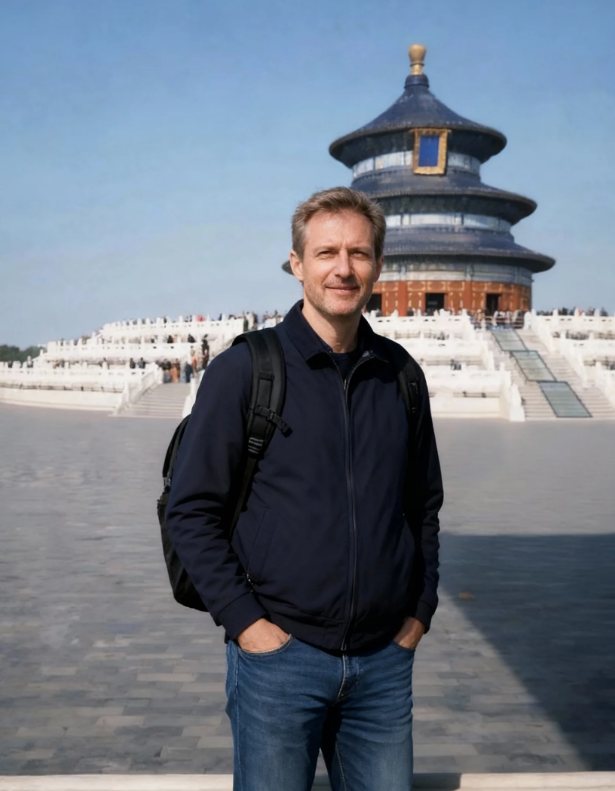
Xi’an: The Dust of Empires and the Scent of Cumin
If Beijing is the head of China, Xi’an is its soul. This was the start of the Silk Road, the capital of ancient dynasties.
I arrived by high-speed train, watching the landscape shift from the North China Plain to the loess plateau. My first stop was, inevitably, the Terracotta Warriors. It is a cliché for a reason. Walking into that massive pit, the scale hits you physically. Thousands of life-sized soldiers, each with a unique face—a mustache here, a topknot there. I stared into the eyes of a kneeling archer encased in glass. He looked determined, stoic. I wondered about the artisan who molded his face two millennia ago. Did he model it after his brother? His friend? It was a ghostly reunion with the past.
But my most vivid memory of Xi’an isn't the clay soldiers. It’s the cycling.
I rented a battered bicycle to ride atop the Ancient City Wall. It was late afternoon. The wall is wide, a paved road elevated above the city. To my left was the old city, with low tiled roofs and bell towers; to my right, high-rises and flashing neon. I pedaled into the setting sun. The wind was warm. I passed couples taking wedding photos, the bride’s red dress flowing against the grey stone. I felt a strange sense of freedom, riding on the border between the past and the present.
Hunger drove me down to the Muslim Quarter that night. It was a sensory overload. The air was thick with smoke and the aggressive, delicious smell of roasting lamb and cumin. "Roujiamo!" a vendor shouted, handing me a flaky bun stuffed with chopped meat. It was hot, greasy, and incredible. I sat on a plastic stool, surrounded by locals cracking walnuts and slurping soup, realizing that history isn't just in museums. It’s in the recipes passed down through generations, alive and bubbling in these iron pots.
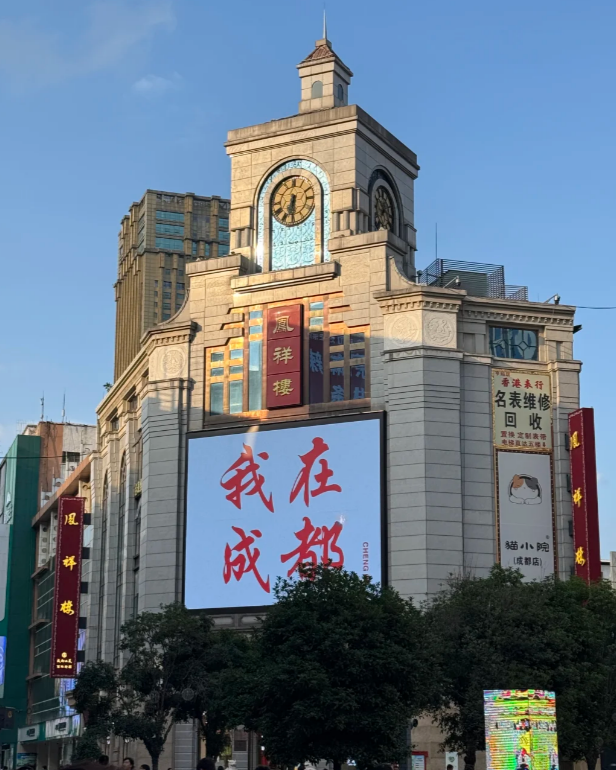
Chengdu: Tea, Mahjong, and the Art of Doing Nothing
After the intensity of the north, Chengdu felt like a deep exhale. They say, "Once you come to Chengdu, you never want to leave." I didn't believe it until I sat in a teahouse in People's Park.
This wasn't a Starbucks experience. I sat in a bamboo chair, listening to the rhythmic clacking of Mahjong tiles that echoed through the park like a heartbeat. I ordered a cup of Jasmine tea. The waiter poured the boiling water from a long-spouted copper kettle with the grace of a dancer.
I watched the locals. There was no rushing. People were getting their ears cleaned by professionals with long metal tools (a terrifying but apparently relaxing local custom), chatting, or simply staring at the trees. I struck up a conversation with a retired teacher at the next table. He told me, "In Beijing, they talk about policies. In Shanghai, they talk about money. In Chengdu, we talk about what to eat for dinner."
And oh, the dinner. I thought I could handle spice. I was wrong.
I visited a hot pot restaurant that evening. The pot bubbling in front of me was a cauldron of red oil and chilies. The heat didn't just burn; it numbed. It was the famous Sichuan peppercorn—Ma La. My lips tingled, my forehead sweated, but I couldn't stop eating. The flavors were complex, floral, and addictive. Amidst the steam and the noise of clinking beer glasses, I felt a warmth that wasn't just from the peppers. Chengdu welcomed me not as a tourist, but as a guest at a loud, happy family reunion.
Of course, I saw the pandas. They were adorable, rolling around in their sanctuaries. But the true spirit of Chengdu wasn't the black and white bear; it was the grey-haired lady laughing over a winning Mahjong hand, proving that life is meant to be enjoyed, not just endured.
Yangshuo: Sailing Through an Ink Painting
Leaving the cities behind, I flew south to Guilin and traveled to Yangshuo. I had seen these mountains on the 20 Yuan banknote, but reality is far more HD than currency.
The landscape here doesn't look real. It looks like a child drew mountains—steep, jagged cones sprouting vertically from the flat green earth. I rented a bamboo raft to drift down the Yulong River. Unlike the motorized boats on the main Li River, this was quiet. The only sound was the bamboo pole dipping into the water.
The water was glass-clear. I could see swaying weeds and small fish darting below. The mountains loomed over us, shrouded in a light mist that made the whole world look like a traditional Chinese ink wash painting. My raftsman, a weathered local with a cigarette permanently dangling from his lips, pointed to a peak. "That one is Moon Hill," he grunted. He started singing a folk song, his voice rough and echoing off the water.
I closed my eyes. The humidity here was heavy, smelling of wet earth and rice paddies. It was incredibly peaceful. Later, I rented a scooter and got lost in the countryside. I drove past water buffalo wallowing in mud, farmers planting rice knee-deep in water, and old stone bridges covered in moss.
I stopped at a roadside stand to buy a pomelo. The woman peeling it didn't speak English, and I didn't speak Mandarin. We communicated with smiles and hand gestures. She handed me the sweet, citrusy fruit, and I sat by the road, watching the sun dip behind a limestone peak. In the cities, China dazzles you with its scale. Here, in the countryside, it humbles you with its beauty.
Shanghai: A Dance Between Two Shores
My final stop was Shanghai. If Beijing is history, Shanghai is the future.
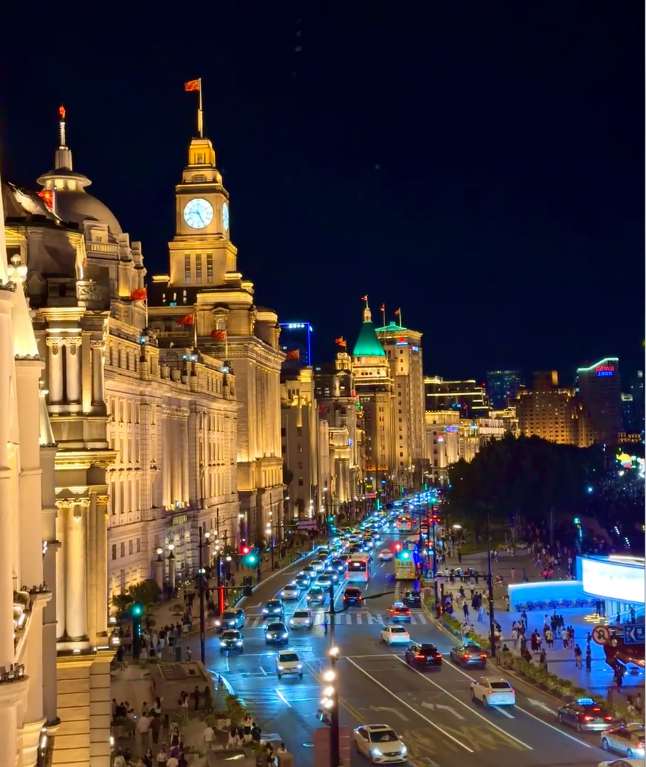
I headed straight for the Bund. Standing on the promenade, looking across the Huangpu River, is perhaps the most visual history lesson in the world. Behind me stood the colonial architecture of the 1920s—sturdy, European, neoclassical stone buildings that whispered of an era of jazz and foreign powers. Across the water lay Lujiazui—a sci-fi skyline of twisting glass towers, glowing spheres, and the towering Shanghai Tower piercing the clouds.
It was raining lightly. The neon lights from the skyscrapers reflected on the wet pavement, turning the ground into a kaleidoscope of colors. I took the ferry across the river for a few cents. Standing on the deck, sandwiched between commuters and tourists, I felt the energy of the city. It was electric, fast, ambitious.
But I found my favorite moment in the French Concession. The streets here are lined with London Plane trees, their leaves creating a green canopy over the road. I walked past trendy boutiques and wine bars, but then I turned a corner and found a Longtang (lane house) neighborhood. Laundry hung on bamboo poles across the narrow lanes. The smell of frying scallions mixed with the scent of expensive perfume from the main street.
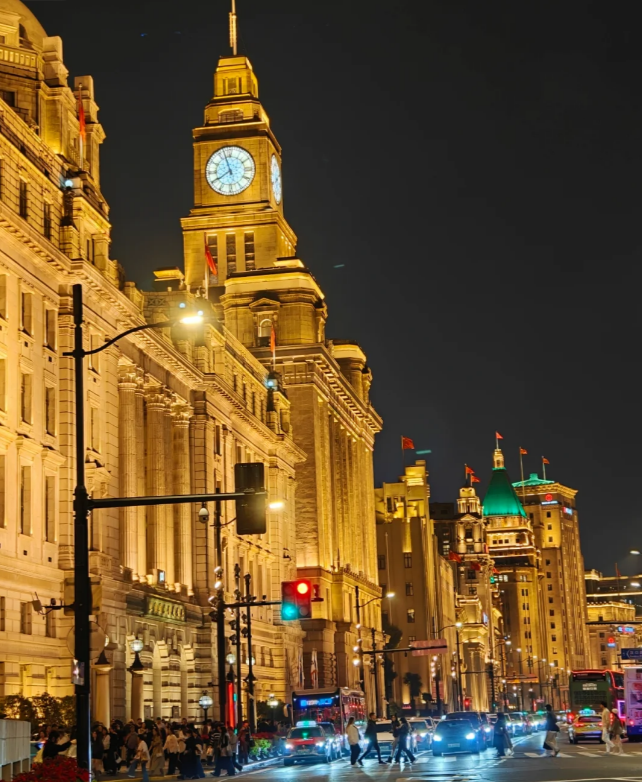
I sat in a jazz bar that night, listening to a band play a saxophone cover of an old 1930s Shanghai pop song. It was melancholy and glamorous. Shanghai felt like a woman who remembers her past but is relentlessly focused on her future. It was the perfect place to end my trip—a reminder that China is not one thing. It is the old man with the bird, the spicy hot pot, the silent mountain, and the neon skyscraper.
Epilogue: Why You Must Go
As I packed my bag to leave, I realized my suitcase was full of souvenirs, but my heart was full of something else.
China is challenging. It is loud, it is crowded, and the language barrier is real. You will get lost. You will order food you can't identify. But that is exactly why you must go.
The magic of China isn't just in the "sights." It is in the morning Tai Chi in the parks, the steam rising from a basket of dumplings, the kindness of a stranger helping you with directions on a subway app. It is a place that forces you to open your eyes and your mind.
So, pack your bags. Be hungry, be curious, and be ready. The Middle Kingdom is waiting, and I promise you, it is unlike anywhere else you have ever been.
Bon voyage, my friends.