The Train Ride That Felt Like Time Travel
I left Xi’an just after sunrise, boarding a local train that rattled eastward toward Lintong. Outside the window, the urban sprawl quickly gave way to patchwork fields—wheat turning gold in the late spring sun, persimmon trees heavy with unripe fruit, and the occasional farmer guiding an ox-drawn plow along furrows older than memory. There were no billboards, no chain stores, just red-tiled farmhouses and laundry fluttering on bamboo lines like prayer flags.

I’d seen countless photos of the Terracotta Warriors. I’d read about them in textbooks, watched documentaries, even built a tiny Lego version as a kid (admittedly, it looked more like a confused garden gnome). But none of that prepared me for the quiet gravity of actually going there—not as a student or a spectator, but as a human being standing on the same soil where history cracked open in 1974.
The museum’s official name is “The Museum of Qin Shi Huang’s Mausoleum,” but no one calls it that. Everyone says “the Terracotta Warriors,” as if the clay soldiers had long since eclipsed their emperor in fame. And maybe they have. After all, he wanted immortality—but it’s they who got it.
As the train slowed into Lintong station, my palms were slightly sweaty. Not from nerves, exactly. More like reverence. I’d traveled across continents to stand before pyramids, cathedrals, ancient ruins—but this felt different. This wasn’t just architecture or art. This was an army. Frozen. Waiting.
A rickshaw driver with a grin and a missing front tooth offered me a ride. “Warriors?” he asked. I nodded. “Good,” he said. “They don’t talk much, but they’ve got plenty to say.”
Pit 1: The Moment the World Stopped Breathing
The walk from the entrance to Pit 1 took ten minutes—past souvenir stalls selling miniature warriors, past cafés offering “emperor’s tea,” past crowds snapping selfies with life-sized replicas. I tried not to rush. I wanted to arrive properly, like you’d approach a temple.
Then I turned the corner—and stopped dead.
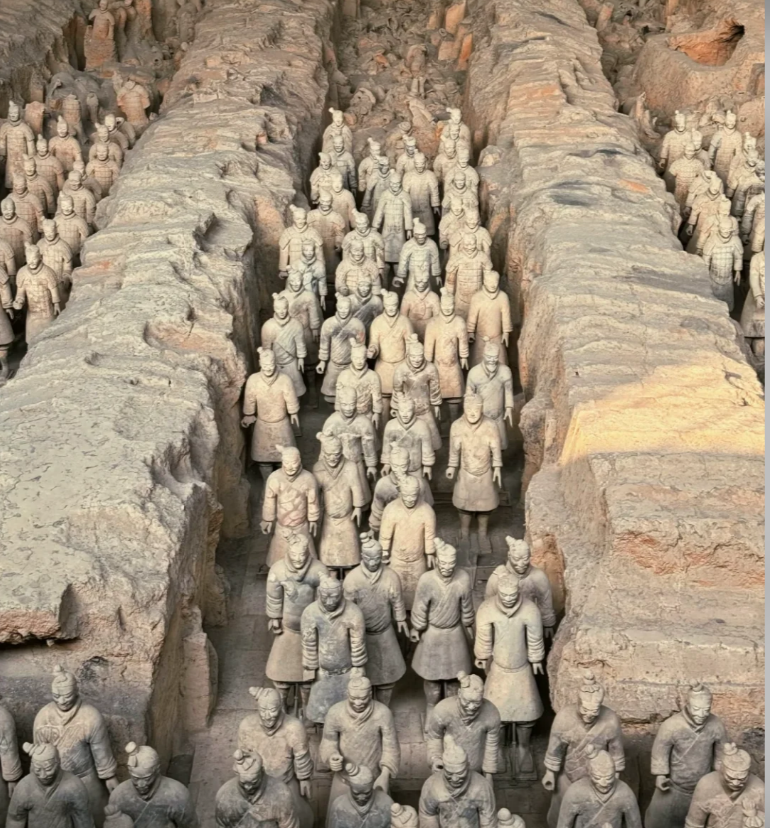
Pit 1 is vast. Imagine a football field buried under a hangar-like structure, filled not with grass or players, but with over 6,000 life-sized clay soldiers standing in precise military formation. Infantry in the front, archers behind, chariots spaced like chess pieces. They face east—as if still guarding against invasion from the lands beyond the empire.
But what struck me wasn’t the scale. It was the silence.
No music played. No loudspeakers boomed facts. Just the soft shuffle of shoes on concrete, the occasional whisper, and the low hum of climate control keeping the fragile pigments from fading. The air smelled faintly of dust and cool stone. Sunlight filtered through high skylights, casting long shadows over the ranks.
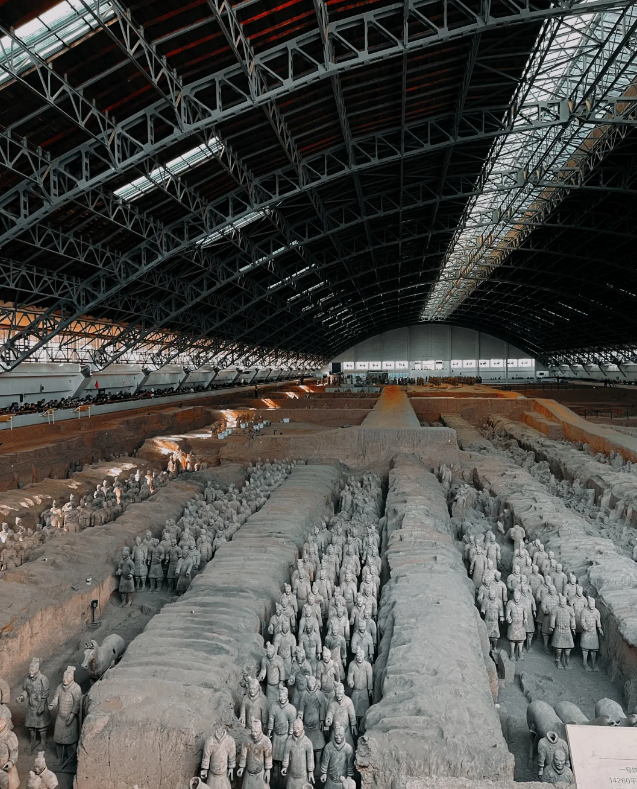
I leaned against the railing, heart thudding. Up close, the details were staggering. Each warrior stood about six feet tall, armored in meticulously rendered lamellar plates. Their faces—oh, their faces—were all different. Some had thick brows and square jaws; others looked boyish, almost scared. One near the front had a slight smirk, as if he knew a secret. Another stared straight ahead, eyes hollow yet intense.
“They say the artisans modeled them after real soldiers,” a voice beside me murmured. I turned to see an elderly Chinese man, his hands clasped behind his back. “Each one had a name. A mother. A story. Now they’re famous, but no one knows who they were.”
I hadn’t thought of that. We celebrate the discovery, the artistry, the engineering—but rarely the men these figures replaced. Were they volunteers? Conscripts? Did they know they’d be immortalized in clay while their own bones turned to dust?
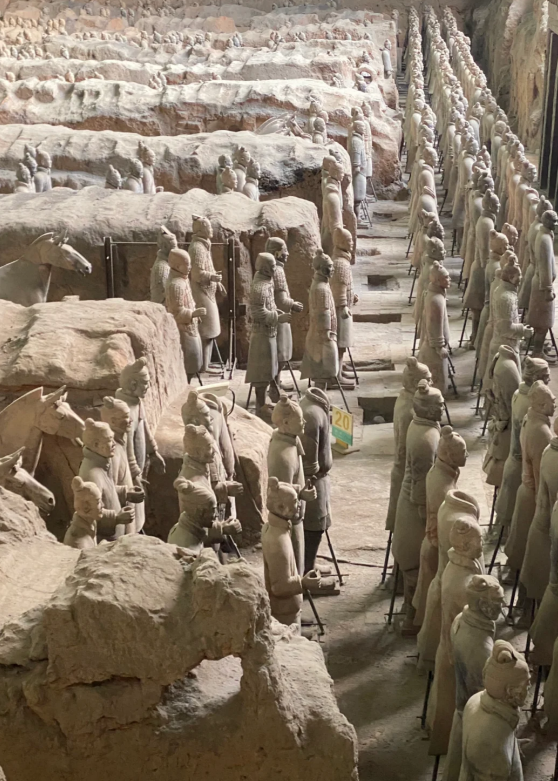
I walked the entire perimeter slowly, taking it all in. In some sections, warriors lay toppled, broken—victims of the roof collapse that sealed the pits centuries ago. Archaeologists work on-site, painstakingly reassembling fragments like a puzzle with no picture on the box. One technician sat cross-legged on a platform, brushing dirt from a warrior’s hand with a camel-hair brush. It took her twenty minutes to clean a single finger.
“Why so careful?” I asked softly.
She didn’t look up. “Because once it’s gone, it’s gone forever. This isn’t just clay. It’s memory.”
Beyond the Main Pit: Secrets in the Smaller Chambers
After the overwhelming grandeur of Pit 1, I wandered toward Pits 2 and 3—smaller, less crowded, but in some ways more intimate.
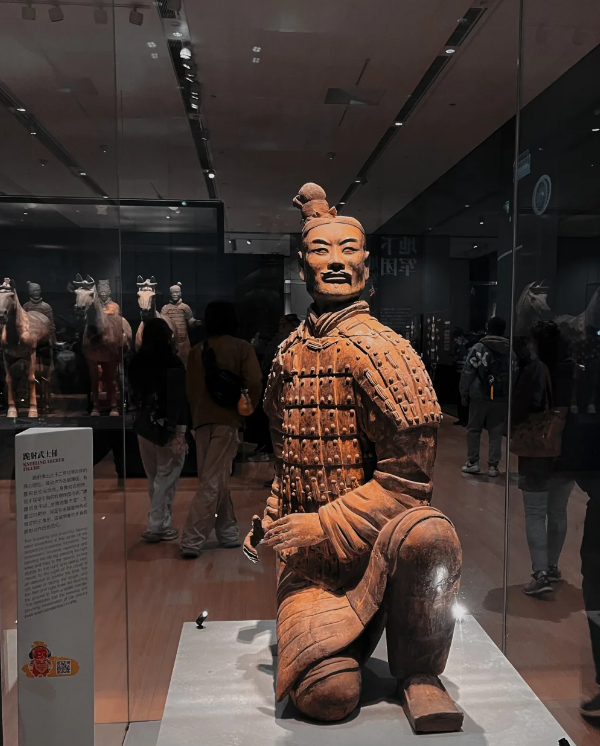
Pit 2 was a tactical dream: cavalry units with armored horses, kneeling archers poised to fire, command officers with elaborate headdresses. Here, the variety was stunning. One horse stood proudly, its mane braided, nostrils flared as if snorting at the modern world. A general nearby wore nine layers of robes—symbolizing his rank—and his expression was calm, authoritative. You could almost hear him barking orders.
But it was Pit 3 that moved me most. It’s believed to be the army’s command post—a small chamber with only 68 figures, including a lone commander standing center stage. Unlike the rigid ranks of Pit 1, this space felt… human. Like a war room frozen mid-debate. The walls were closer, the ceiling lower. I could imagine torchlight flickering here 2,200 years ago, maps spread on the floor, voices tense with strategy.
Nearby, a display case held two of the most astonishing artifacts I’ve ever seen: the Bronze Chariots. Discovered near the emperor’s burial mound, these life-sized carriages are made of thousands of intricately cast bronze parts—reins, wheels, canopies—even tiny umbrella holders for shade. The horses’ eyes are inlaid with black stone; their muscles ripple under polished metal. They look ready to gallop off the pedestal.
A plaque explained that each chariot weighed over a ton and took decades to reconstruct. I crouched to eye level with one horse. Its gaze was steady, eternal. “You were meant to carry a god-king into the afterlife,” I whispered. “Instead, you carry wonder into ours.”
The Emperor’s Tomb: The Mountain That Keeps Its Secrets
After the museum, I took a short bus ride to the actual mausoleum of Qin Shi Huang—the great earthen pyramid that rises like a sleeping beast from the plain.
It’s deceptively simple: a forested mound about 75 meters tall, surrounded by a moat and guarded by stone stelae. No grand palace, no golden spire. Just earth, trees, and silence.
Archaeologists believe the tomb chamber lies 30 meters below ground, untouched since 210 BCE. Ancient texts describe it as a microcosm of the empire: rivers of mercury flowing beneath a ceiling studded with pearls representing stars, the emperor seated on a throne of jade, surrounded by treasures and—perhaps—his real courtiers, buried alive to serve him forever.
To this day, no one has excavated it. Ground-penetrating radar confirms high mercury levels, matching historical accounts. But out of respect—and caution—the tomb remains sealed. “We’re not ready,” a guide told me. “Not technologically. Not ethically. Some doors should stay closed until we’re wise enough to open them.”
I walked the circular path around the mound, listening to birds and wind in the pines. It felt strange: the most powerful man of his age, who unified China, standardized writing and currency, built the first Great Wall—now lies in a quiet hill, overshadowed by the army he created to protect him.
Was it irony? Or prophecy?
He sought eternal rule. Instead, he gave us a mirror: a reflection of human ambition, ingenuity, and the haunting truth that even emperors are mortal—but the lives they touch may echo far longer than their own.
Dinner and Reflections: What the Warriors Taught Me
That evening, I ate at a small noodle shop back in Lintong. The owner, a woman with silver-streaked hair and quick hands, served me youpo mian—hand-pulled noodles in a rich, oily broth flecked with chili and scallions. Simple. Honest. Filling.
As I ate, I thought about the farmers who discovered the warriors in 1974 while digging a well. They hit hard clay, then a head. At first, they thought it was a kiln ruin. Then they found more bodies. They reported it to local officials, who dismissed it as “old pottery.” It took months for archaeologists to realize what they’d uncovered.
Now, millions visit every year. UNESCO declared it a World Heritage Site. Books, films, exhibitions span the globe.
But those farmers never asked for fame. They just needed water.
There’s a lesson there, I think. Greatness often hides in plain sight—buried under routine, overlooked by haste. The warriors weren’t found by kings or scholars. They were found by ordinary people doing ordinary work.
Back in my guesthouse that night, I opened my journal. I didn’t write much. Just: They don’t guard an emperor. They guard our capacity to remember.
Because that’s what the Terracotta Army really is—not a military force, but a monument to memory. To the idea that every life, even one lost to time, deserves to be seen.
Before I slept, I looked out the window at the dark silhouette of Mount Li in the distance—the same mountain whose clay was used to mold those faces. The wind rustled the leaves. Somewhere, a dog barked. And for a moment, I imagined the silent army standing watch not over a tomb, but over us—reminding us to live fully, to leave something kind behind, and to never forget that we, too, are part of someone else’s future history.
I returned to Xi’an the next day. The city felt louder, faster, brighter. But inside me, something had shifted.
I no longer see the Terracotta Warriors as just an attraction. They’re a threshold. Cross it, and you don’t just learn about ancient China—you confront your own place in the long river of time.
If you go, don’t rush. Don’t just snap a photo and move on. Stand quietly. Look into their eyes. Ask yourself: What will I leave behind that someone, centuries from now, might kneel to restore with a camel-hair brush?
Because in the end, we’re all clay.
But some of us choose to stand.