I. Arrival in the Land Where Time Stands Still
I stepped off the high-speed train into Xi’an’s North Railway Station just after noon, and the first thing that hit me wasn’t the heat—it was the smell. Dry earth, roasted sweet potatoes from a street cart, and something deeper, older, like stone breathing after centuries underground. The air felt thick with memory.
I’d read about Xi’an for years—how it was once Chang’an, the eastern terminus of the Silk Road, capital to thirteen dynasties, home to emperors who ruled half the known world. But nothing prepared me for the sheer weight of time pressing down on this city. Unlike Shanghai’s vertical rush toward tomorrow, Xi’an sprawls low and wide, as if bowing respectfully to its own past.

My hotel was near the South Gate of the city wall, so I dropped my bag and walked straight there, drawn like a compass needle. The Ming Dynasty wall—14 kilometers of tamped earth faced with brick—rose before me like a fortress from a dream. Locals strolled along the top on rented bicycles; kids flew kites shaped like dragons over the moat. I bought a ticket and climbed the steep stone ramp, my fingers brushing the sun-warmed bricks. At the top, the view opened up: tiled rooftops, pagoda spires, and in the hazy distance, the faint silhouette of the Qinling Mountains. For a moment, I imagined messengers galloping along this very rampart, carrying scrolls that would shape empires.
That evening, I wandered into the Muslim Quarter—not yet ready for the crowds, but curious. Lanterns glowed amber above narrow alleys, casting long shadows over stalls selling candied hawthorns, rose-scented cakes, and lamb skewers sizzling over charcoal. The scent of cumin and chili oil hung in the air like incense. A vendor handed me a paper cone of yang rou paomo—crumbled flatbread soaked in rich mutton broth—and said, “Eat slow. The flavor needs time.” I did. And as I slurped the fragrant soup under a sky pricked with stars, I felt it: I wasn’t just visiting Xi’an. I was being welcomed into its rhythm.
II. Facing the Silent Army
No one tells you how quiet the Terracotta Warriors are.
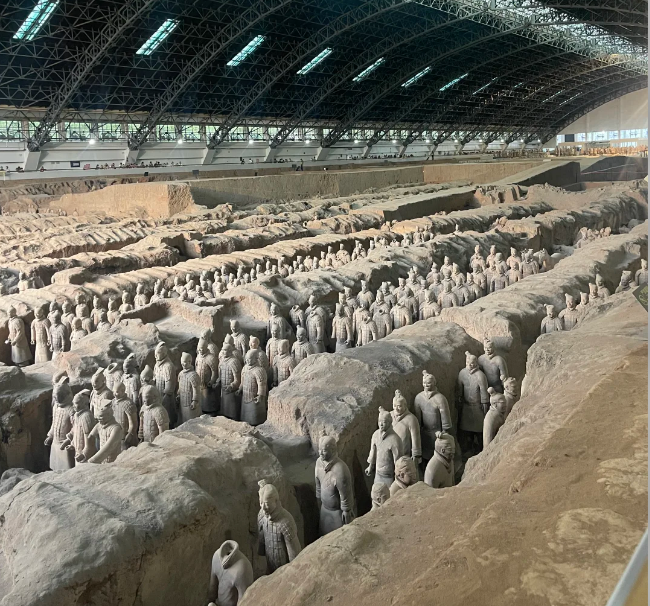
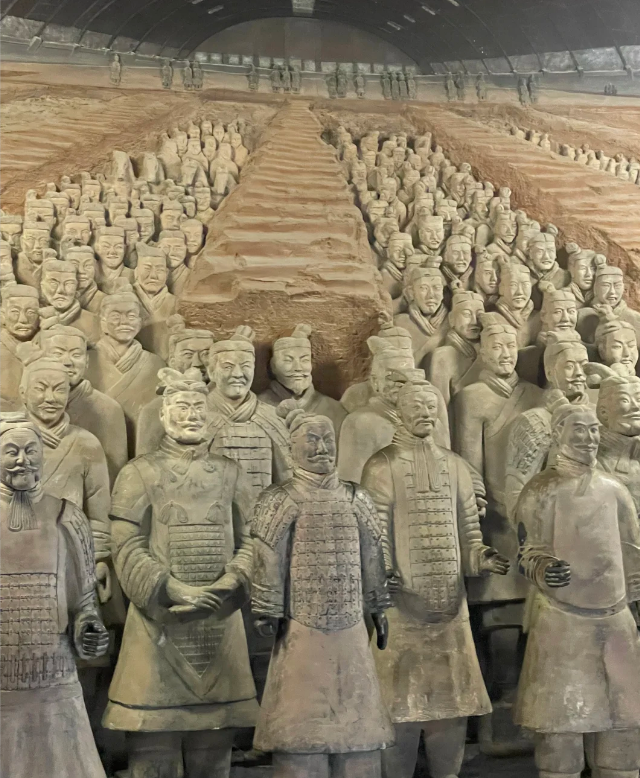
You expect awe, scale, maybe even grandeur—but not silence. Yet as I stood in Pit 1 at the Museum of Qin Shi Huang’s Mausoleum, the only sounds were the shuffle of sneakers, the occasional whisper, and the low hum of climate control. Before me stretched an army of over 6,000 life-sized clay soldiers, frozen mid-march for more than 2,200 years. Each face unique—some stern, some young, some weary—as if the artisans had modeled them after real conscripts.
I leaned against the railing, heart pounding not from excitement, but from intimacy. These weren’t statues. They were stand-ins for men who once breathed, sweated, feared death. One warrior near the front had faint traces of green pigment on his armor—remnants of paint that once made the army blaze with color. I thought about the emperor who ordered this: Qin Shi Huang, the unifier of China, obsessed with immortality, buried beneath a mound of earth with rivers of mercury and a celestial map on his tomb ceiling. He wanted to rule forever. Instead, he left us this silent testament to human ambition and fragility.
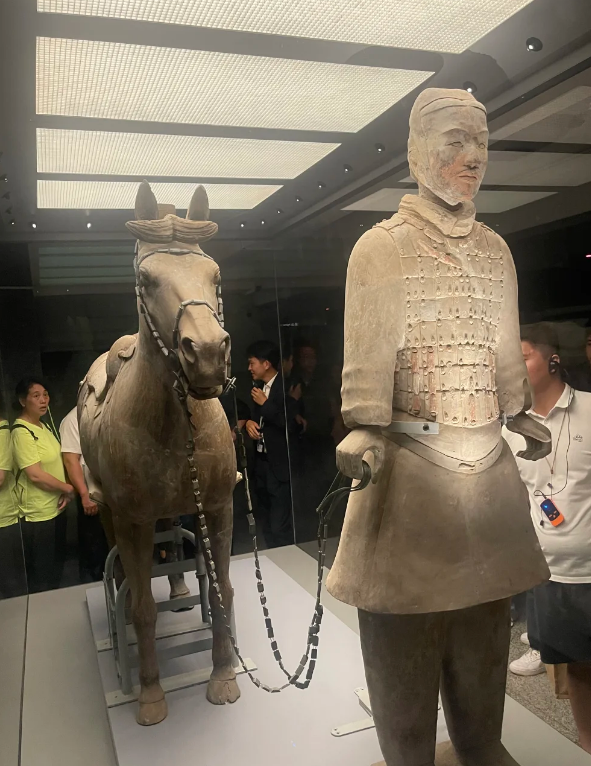
Later, in the smaller pits, I saw bronze chariots so finely crafted they looked ready to roll away, horses with flared nostrils and taut muscles. A guide nearby explained how the warriors were discovered in 1974 by farmers digging a well. “They thought they’d hit a kiln,” she said. “Instead, they unearthed an empire.”
I left the museum in a daze, the afternoon sun harsh on my skin. Back in the parking lot, a street artist was sketching portraits for tourists. I asked him why he worked here. He smiled. “Because history isn’t just in the ground. It walks with us. We just forget to look down.”
III. Cycling the Wall at Dusk
The next morning, I rented a bike and rode the full circuit of Xi’an’s city wall—13.7 kilometers of elevated pathway atop 600-year-old fortifications.
It started easy: pedaling past watchtowers draped in morning mist, the city waking below—delivery scooters weaving through alleys, shopkeepers rolling up metal grates, the distant chime of a temple bell. But by the third kilometer, my thighs burned. The wall is deceptively flat, but the wind picks up at height, and the sun beats down without mercy. Still, I kept going.
What struck me most wasn’t the exercise, but the perspective. From up here, Xi’an revealed itself as a palimpsest. Ancient drum and bell towers stood like anchors in a sea of modern traffic. Beneath the wall, electric buses rumbled past noodle shops where chefs hand-pulled biangbiang noodles with theatrical flair. In one quadrant, construction cranes hovered over new apartments; in another, a group of elderly women practiced fan dance in a park, their movements synchronized like clockwork.
I stopped halfway, leaning on the parapet, watching clouds drift over the Small Wild Goose Pagoda. A German couple pulled up beside me, out of breath. “Worth it?” I asked. The man grinned. “It’s like riding on the spine of history.”
As dusk fell, I reached the South Gate again. The lanterns lit up one by one, turning the wall into a glowing ribbon. Below, the city pulsed with life—honking, laughing, cooking. And I realized: walls are meant to divide, but this one connected. Past and present. Tourist and local. Stranger and story.
IV. Mountains, Mist, and Monks at Huashan
On my fourth day, I took a bullet train east to Huashan—one of China’s Five Great Mountains, sacred to Taoists and notorious among hikers for its vertiginous plank paths bolted to sheer cliffs.
I didn’t climb the Plank Walk (not this time). Instead, I took the cable car up and hiked the less treacherous East Peak trail. Even so, the mountain demanded respect. Stone steps carved into rock, chains for handholds, sudden drops that made my stomach lurch. But the higher I went, the quieter the world became. The chatter of tourists faded, replaced by wind whistling through pines and the occasional cry of a hawk.
At the summit, I found a small Taoist temple clinging to the edge of the world. An old monk sat outside, sweeping fallen leaves with a broom made of twigs. He didn’t speak, just nodded as I passed. Inside, incense coiled upward from bronze burners, and wooden plaques bore wishes written by pilgrims: “Health for my mother,” “Pass the exam,” “Find peace.”
I sat on a stone bench, eating a steamed bun I’d bought at the base, and watched clouds roll through the valleys like slow rivers. Down below, Xi’an was invisible—a smudge of civilization swallowed by earth and sky. Up here, time didn’t feel linear. It felt circular, eternal. The same mountains that sheltered hermits in the Tang Dynasty now host selfie-stick-wielding backpackers. And somehow, both belong.
On the descent, I met a young Chinese woman hiking alone. “Why Huashan?” I asked. She laughed. “To prove I can be still. In the city, my mind never stops. Here… it has to.”
I understood. Xi’an doesn’t just show you history—it gives you space to reflect on your own place within it.
V. A Bowl of Noodles and the Taste of Home
My last night in Xi’an, I skipped the touristy spots and followed a local’s tip to a tiny noodle shop near the Bell Tower, tucked between a pharmacy and a laundromat.
The place had no name, just red plastic stools and a counter where a man in a flour-dusted apron slapped dough onto a wooden board with rhythmic thwacks. This was biangbiang mian—wide, belt-like noodles tossed in chili oil, garlic, vinegar, and hand-chopped greens. He served it in a bowl bigger than my face.
I ate slowly, savoring each chewy strand, the heat building gently on my tongue. Around me, office workers slurped silently, families shared plates of pickled vegetables, and two students debated philosophy over dumplings. No one spoke English. No one cared. I was just another hungry soul at the table.
Afterward, I walked back through the Muslim Quarter, now alive with neon and music. But I didn’t stop to shop or take photos. I just walked, letting the city’s pulse sync with mine. Somewhere, a flute played a folk tune. Somewhere else, a wok hissed.
Xi’an doesn’t shout. It murmurs. You have to lean in to hear it—in the clink of teacups at a courtyard café, in the rustle of silk robes in a museum, in the steam rising from a street-side pot.
And when you do, it tells you stories older than nations, yet as fresh as tonight’s dinner.
I left Xi’an on a rainy morning, the city wrapped in a soft gray veil. As the train pulled away, I pressed my forehead to the window, watching the city wall shrink into the mist. I carried no souvenirs—just the taste of cumin-laced lamb, the echo of silent warriors, and the quiet certainty that I’d touched something ancient and enduring.
Xi’an isn’t just a stop on a tour itinerary. It’s a mirror. It asks: What will you leave behind? How will you be remembered?
And for a few days, walking its walls and tasting its dust, I felt part of a story much bigger than myself—one written in clay, stone, and noodles, waiting patiently for the next traveler to turn the page.