The plane touched down in Dunhuang just after noon, and as I stepped onto the tarmac, the air hit me like a dry kiss—thin, hot, and scented with dust. No humidity, no ocean breeze, just the raw breath of the Gobi Desert pressing in from all sides. I’d flown over endless beige ripples for the last hour, and now I was standing in the middle of them.
Dunhuang isn’t on most travelers’ radars. It’s not Shanghai with its neon, or Xi’an with its armies of clay. It’s a town of 200,000 souls clinging to an oasis at the western edge of China’s Gansu Province, where the Hexi Corridor pinches shut against the Taklamakan Desert—the “Sea of Death,” as ancient traders called it. And yet, for over a thousand years, this speck in the sand was one of the most important places on Earth.

Why? Because it sat at the crossroads of the Silk Road. Caravans laden with silk, spices, glass, and ideas converged here before vanishing into the dunes. And they left something behind—not gold, but something far more enduring: art, faith, and stories painted on cave walls.
I checked into a modest guesthouse near the downtown square, where a single camel statue stood guard under a blazing sun. My host, a woman named Li Wei (though she insisted I call her “Auntie”), handed me a cup of warm goji berry tea. “Drink,” she said. “The desert steals your moisture before you notice.” Her hands were rough from years of gardening, but her eyes sparkled. “Tomorrow, you go to Mogao. Today, rest. Let the sand settle in your bones.”
I did. I walked through the quiet streets, past stalls selling dried jujubes and apricots, past murals of flying apsaras on concrete walls, past children chasing each other around a fountain shaped like a lotus. There was a stillness here unlike anywhere else I’d been—a kind of waiting silence, as if the whole town were holding its breath for the wind to speak.
That night, I lay on my narrow bed, listening to the faint whistle of sand against the window. I thought about the monks who came here centuries ago, seeking solitude in this barren land. Why here? Why not somewhere greener, gentler?
Then I remembered: enlightenment doesn’t bloom in comfort. It rises from emptiness.
II. The Caves That Whispered for Centuries
At dawn, Auntie drove me to the Mogao Caves—25 kilometers southeast of town, carved into the face of Mingsha Mountain (“Singing Sand Mountain,” named for the eerie hum its dunes make when the wind shifts).
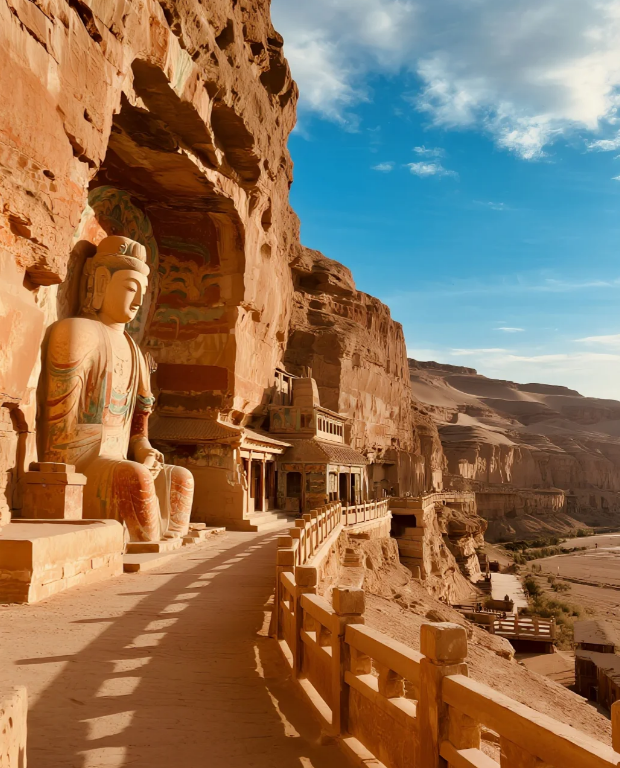
We arrived before the crowds. The site was already stirring—guards unlocking gates, guides checking headsets—but the cliffs themselves loomed silent, pockmarked with nearly 500 caves honeycombed into the soft conglomerate rock. From a distance, they looked like swallow nests clinging to a cliffside.
Entry is strictly controlled. You can’t just wander in; you must join a guided group, and photography inside is forbidden. I’d read about this—it’s to protect the fragile pigments, some over 1,600 years old. But I didn’t mind. Some things aren’t meant to be captured. They’re meant to be felt.
Our guide, a young scholar named Chen, spoke softly, almost reverently. “These caves weren’t built for tourists,” he said. “They were sanctuaries. Places to meditate, to copy sutras, to paint visions of paradise so vivid they could carry you beyond suffering.”
We entered Cave 220 first—a Tang Dynasty masterpiece. The moment the flashlight beam swept across the wall, I gasped. Bodhisattvas floated on lotus thrones, their robes swirling in impossible folds, eyes half-closed in serene compassion. Celestial musicians played lutes and flutes mid-air. Every inch pulsed with color: lapis lazuli blue, malachite green, cinnabar red—all made from minerals ground by hand, mixed with animal glue, applied by artists who believed beauty was a path to the divine.
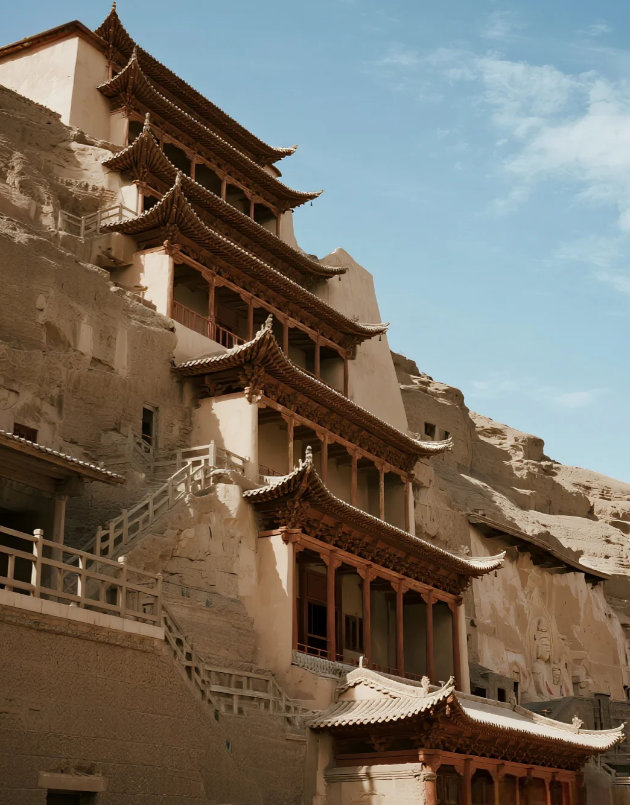
In another cave, we saw the famous “Western Paradise” mural—Buddha presiding over a celestial realm where birds sing scripture and lotus flowers bloom spontaneously. Chen pointed to a tiny figure in the corner: a donor, kneeling, hands clasped. “That’s someone’s ancestor,” he said. “They paid for this painting so their family would be reborn in paradise. We don’t know their name. But their hope is still here.”
I stood there, heart tight. How many prayers had soaked into these walls? How many tears, fears, dreams?
Later, we visited the Library Cave—the one that changed history. In 1900, a Taoist monk named Wang Yuanlu discovered a hidden chamber stuffed with 50,000 manuscripts: Buddhist sutras, Tibetan contracts, Hebrew psalms, even early Christian texts in Syriac. It was the greatest cache of medieval documents ever found. But Wang, poor and devout, sold most of them to foreign explorers for pennies. Today, those scrolls sit in London, Paris, Berlin.
“Was he a thief?” I asked Chen.
He shook his head. “He thought he was saving them. He didn’t know their value. Or maybe… he knew too well, and hoped the world would care.”
As we left, I glanced back at the cliffs. Sunlight glinted off the new visitor center’s glass roof—a modern ark built to protect the ancient ones. I felt a strange mix of awe and sorrow. These caves survived sandstorms, earthquakes, and war. But time, light, and human curiosity are slower, quieter enemies.
Still, they endure. And so do the whispers.
III. Singing Sands and Starlit Silence
That afternoon, I went to Crescent Lake.
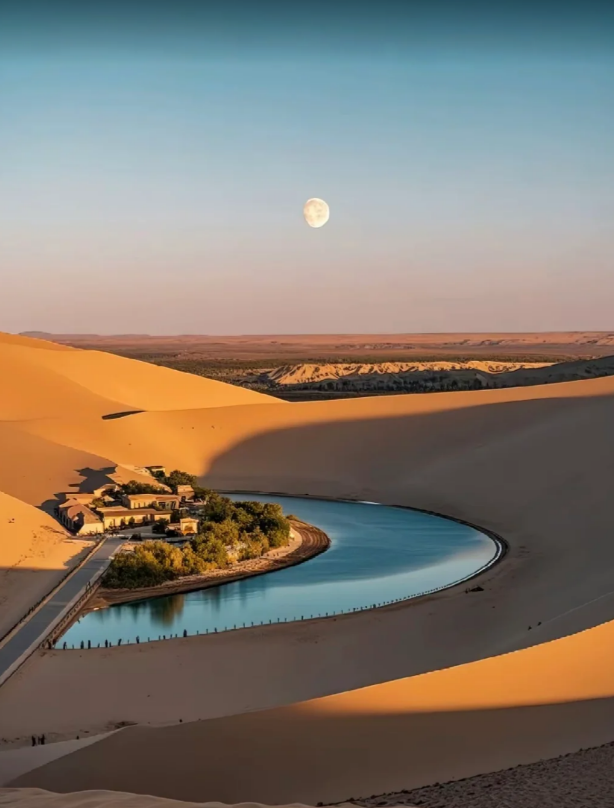
Tucked between towering dunes of the Mingsha Mountains, this spring-fed oasis has existed for over 2,000 years—defying logic, defying the encroaching desert. Legend says it’s shaped like a crescent moon because a goddess wept here, and her tear became water.
I rented a pair of straw sandals (regular shoes sink instantly) and climbed the nearest dune. The sand was fine as powdered sugar, burning hot on the surface but cool just beneath. Halfway up, I slipped, laughed, and started again. At the top, the view stole my breath: golden waves stretching to the horizon, and in the valley below, the emerald jewel of Crescent Lake, ringed by willows and a Ming-era pavilion.
I sat down, letting the wind sift sand through my fingers. A group of tourists rode camels along the lake’s edge, their bells jingling like distant memories of caravans past. But up here, it was just me and the sky.
As dusk fell, I stayed. The temperature dropped fast—desert nights are sharp. I wrapped myself in a scarf and watched the stars appear, one by one, then in torrents. Without city lights, the Milky Way blazed like a river of crushed diamonds. I’d never seen so many stars. It felt less like looking up and more like falling into space.
A lone traveler joined me—a French photographer named Julien. We didn’t talk much. Just sat in silence, sharing a thermos of black tea. Finally, he said, “In Paris, I chase light. Here, I finally understand darkness.”
I knew what he meant. In the city, darkness is absence. Here, it’s presence. It holds you. It reminds you how small you are—and how connected.
Later, walking back, I heard it: the dunes began to hum. A low, resonant drone, like a giant cello bow drawn across the earth. The “singing sand.” Scientists say it’s caused by avalanching grains creating vibrations. But standing there, shivering slightly, I preferred the old belief: the desert is singing to those who listen.
IV. The Taste of Oasis: Dates, Dumplings, and Kindness
Dunhuang’s food tells its own story—one of scarcity turned into abundance.
At a family-run restaurant near the night market, I tried luo han zhai—a vegetarian stew simmered with tofu, mushrooms, lotus root, and local goji berries, served with flatbread baked in a tandoor-like oven. The owner, a Uyghur man named Abdu, explained that Dunhuang sits where Han Chinese, Tibetan, Mongolian, and Central Asian cultures meet. “Our food is a handshake,” he said, placing a bowl of lamb dumplings before me. “No borders on the plate.”
The next morning, I visited the local market. Stalls overflowed with dried melon seeds, wolfberries glowing like rubies, and huge wheels of fermented camel milk cheese. An elderly woman sold mianpian—hand-pulled noodles tossed in chili oil and wild herbs. “From the mountains,” she said, pointing west. “Good for the blood.”
But the real feast came unexpectedly. Auntie invited me to her courtyard for dinner. She’d cooked yang rou chuan (lamb skewers), roasted eggplant with garlic, and a salad of fresh jujube slices and mint. We ate under a grape arbor, the vines heavy with fruit. Her granddaughter, eight years old, practiced calligraphy at a small table, copying a Tang poem about moonlight over the desert.
“Why do you stay here?” I asked Auntie. “It’s so remote.”
She smiled. “Because the desert teaches you what matters. Water. Family. A good story. Everything else is extra.”
After dinner, she played a recording of Dunhuang folk songs—melodies carried on Silk Road winds, blending Persian scales with Chinese pentatonic notes. I closed my eyes and imagined merchants singing the same tunes a thousand years ago, huddled around fires, watching the same stars.
V. Departure: Carrying the Desert Within
On my last morning, I returned to the Mogao Caves—not to enter, but to sit outside.
I brought a notebook and wrote nothing. Just watched pilgrims arrive, scholars leave, children point at the cliffs with wide eyes. A monk in saffron robes walked slowly along the path, chanting under his breath. The wind carried the scent of sagebrush and dry earth.
I thought about how Dunhuang isn’t really a place you visit. It’s a place that visits you—long after you’ve left. Its silence gets into your bones. Its colors stain your dreams. Its stories become your own.
On the flight back, I stared out the window as the Gobi stretched below, endless and beautiful in its austerity. I touched the small pouch in my pocket—filled with sand Auntie had given me. “So you don’t forget,” she’d said.
But I won’t forget.
Because Dunhuang taught me that emptiness isn’t void—it’s potential. That art can outlive empires. That faith can bloom in the driest soil. And that sometimes, the most profound journeys aren’t about seeing the world, but about letting the world see you—stripped bare, humbled, and finally, truly awake.
If you ever go, don’t rush. Sit in the sand. Listen to the wind. Let the caves whisper.
And when you leave, carry only what the desert gives you: silence, wonder, and the courage to keep walking—even when the path disappears into the dunes.