I still remember the morning air hitting my face as I stepped off the bus. It was crisp, thin, and carried a scent that I can only describe as “cold pine and ancient earth.” I was at the entrance of Jiuzhaigou Scenic Area, or the “Valley of Nine Villages.” I had read the brochures, seen the glossy photographs on travel blogs, and listened to friends rave about the colors. But honestly, I was skeptical. How could a lake really be that blue? How could a waterfall look like silk? In my experience, photos often lie, embellishing reality with saturation filters. But as I walked through the gate and heard the distant, rhythmic roar of water, I realized that perhaps, just this once, the photos hadn’t done it justice.

My journey began early. The mist was still clinging to the mountain tops, swirling around the peaks like white scarves. I decided to start my trek at the higher elevations and work my way down, a strategy I highly recommend if you want to watch the light change over the water. The first major stop that left me spellbound was the Five Flower Lake (Wuhua Hai).
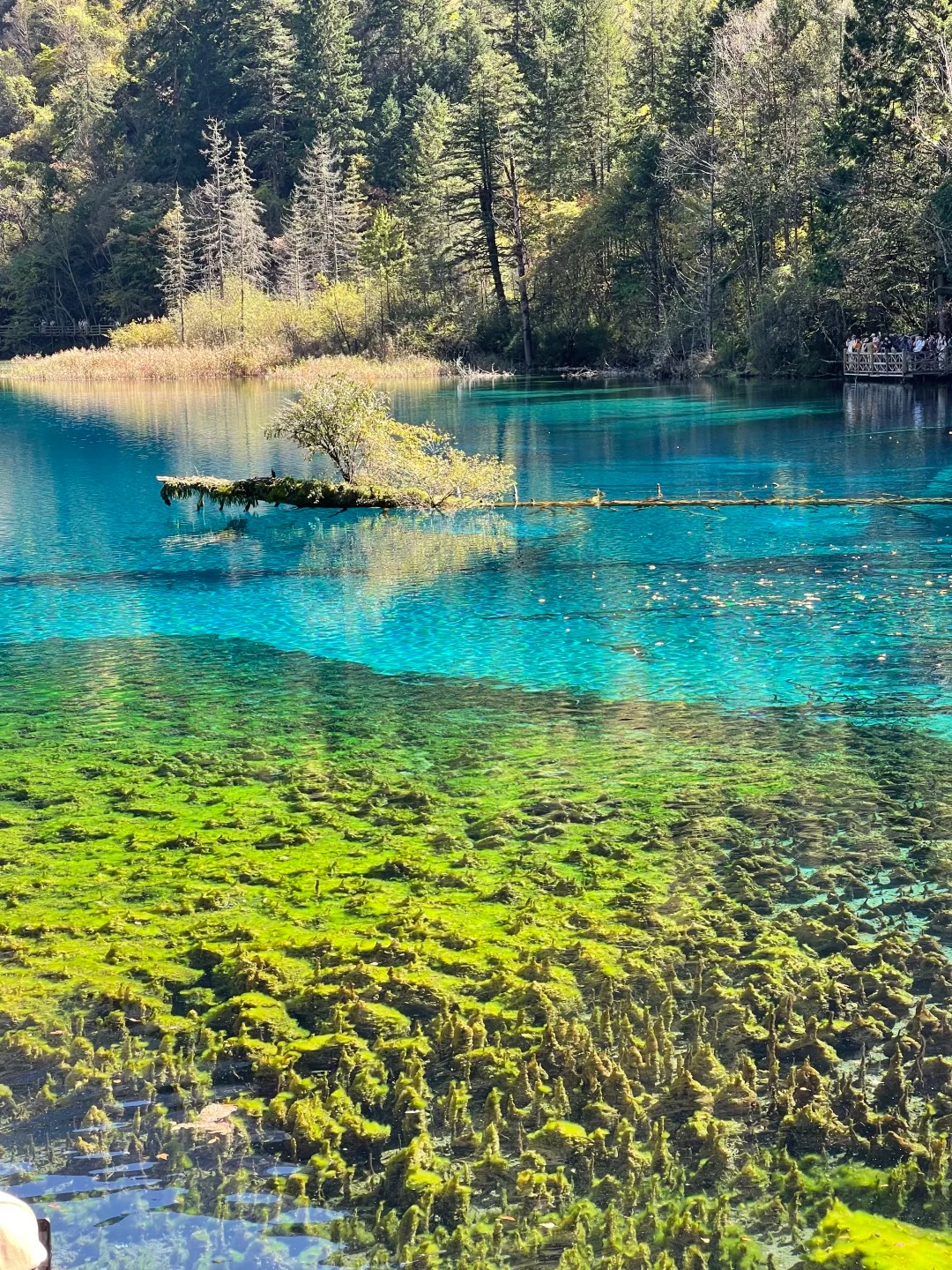
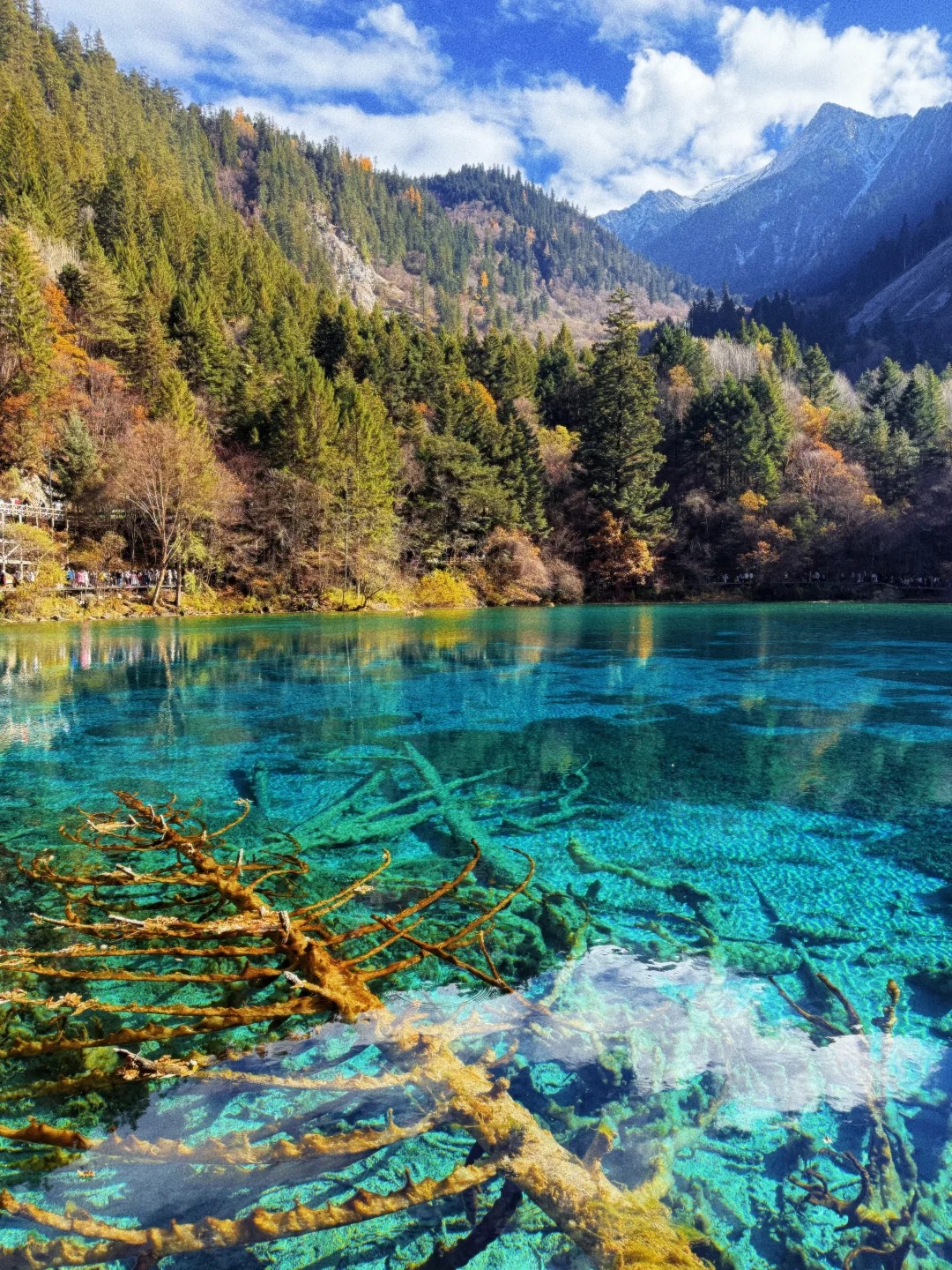
I stood on the wooden boardwalk that curves around the lake, and for a moment, I forgot to breathe. The water wasn’t just blue; it was a mosaic of turquoise, aquamarine, and emerald greens, so transparent it felt like I was hovering over glass. But the most magical part was what lay beneath. Fallen tree trunks, submerged for decades, lay on the bottom. Because the water is so rich in calcium carbonate and other minerals, a crust of calcite has formed over the wood. They didn’t look like rotting logs; they looked like intricate jade sculptures lying on a bed of velvet. It was quiet here, despite the crowds. People seemed to lower their voices instinctively, as if speaking too loudly would shatter the mirror-like surface.
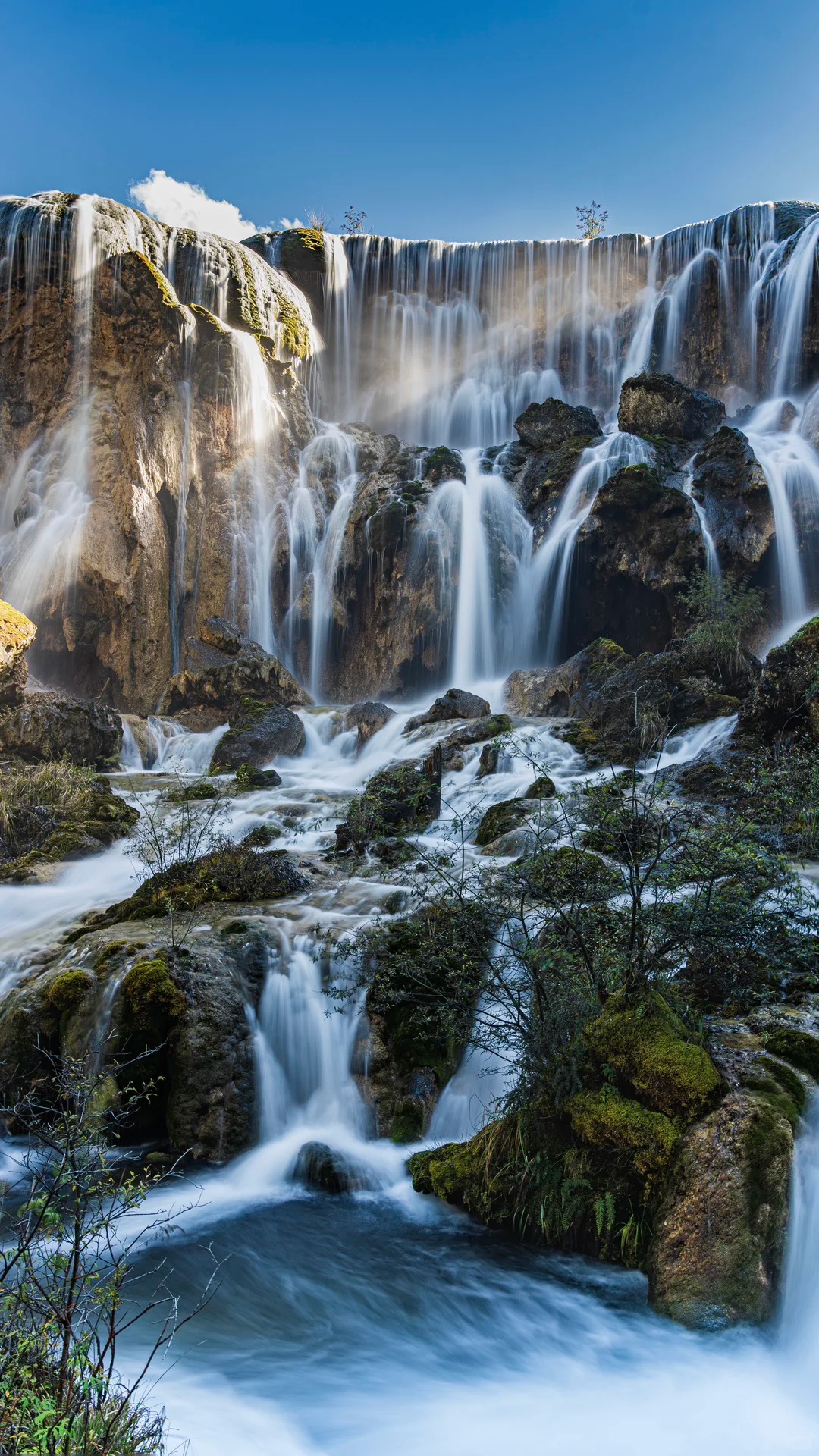
I walked further along the trail, the sound of my footsteps soft on the planks, until I heard a thundering growl ahead. It was the Nuorilang Waterfall. It is one of the widest waterfalls I’ve ever seen, stretching out like a giant curtain draped over the cliff edge. But it wasn’t the size that got to me; it was the texture. The water didn’t just crash down; it flowed over the travertine shelves in a way that looked liquid yet solid, like molten metal being poured from a forge. The spray hit my face, cooling the heat of the mid-morning hike. I found a rock to sit on, away from the main viewing platform, and just watched. Watching a waterfall is hypnotic; the water never stops, yet it never looks the same from one second to the next. It made me feel small, in a good way—a reminder of nature’s relentless, indifferent power.
One of the things that surprised me most about Jiuzhaigou was how the landscape shifted. One minute you are in a dense, mossy forest that feels like a setting from a Grimm’s fairy tale, and the next, you emerge into a wide, colorful valley dotted with Tibetan villages. I stopped at Shuzheng Village for lunch. It was here that the “Nine Villages” part of the name really came to life for me. I met an elderly Tibetan woman sitting outside her stone house, spinning prayer wheel. Her face was weathered, tanned by the high-altitude sun, and her eyes crinkled into a warm smile when I tried to greet her in broken Mandarin.
She invited me in for a cup of butter tea. Now, I know some travelers find butter tea—an acquired taste made from yak butter, tea, and salt—a bit challenging. But sitting in her courtyard, with the sun beating down and the smell of burning juniper incense in the air, it tasted like history. It was rich, salty, and incredibly warming. We didn’t share a language, but we shared the view of the Shuzheng Lakes below. She pointed at the water, then at the mountains, and placed her hands together in a prayer gesture. She was telling me, without words, that this land was sacred. It wasn’t just a “scenic area” to be ticked off a list; it was the provider, the protector, and the home of her ancestors.
As the afternoon wore on, the light began to change, becoming softer and more golden. This is the “magic hour” in Jiuzhaigou. I made my way to Mirror Lake (Jinghai). The wind had died down completely. The surface of the water was so still that it created a perfect illusion. I looked down and saw the inverted reflection of the snow-capped mountains, the blue sky, and the red leaves of the autumn maples. It was dizzying. I couldn’t tell where the earth ended and the water began. I saw a young couple taking wedding photos nearby. The bride, in a flowing white dress, looked ethereal against the backdrop of the crystal water and the looming peaks. It was a scene that felt almost cinematic, yet it was happening right in front of me, raw and unfiltered.
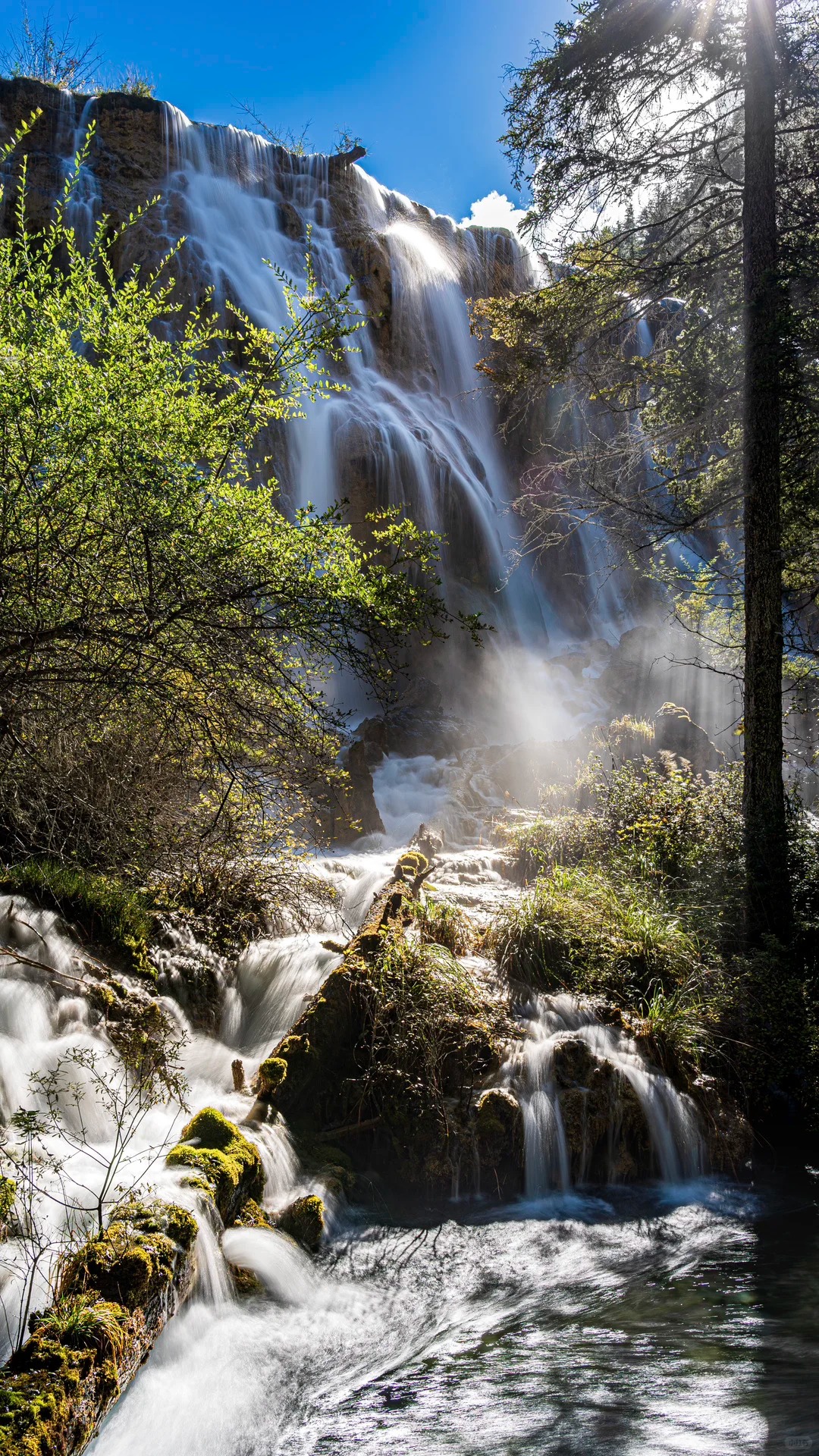
I also want to talk about the Pearl Shoal Waterfalls. You might recognize this place if you’ve seen the famous Chinese TV series *Journey to the West*. The water rushes over a wide slope that is dotted with “pearls”—small calcareous rings that trap the water, causing it to splash and bubble. Watching the water tumble down the 310-meter drop was exhilarating. The energy there is electric. I watched a group of Tibetan teenagers standing near the edge, laughing and shouting over the roar of the water, their colorful traditional clothes fluttering in the wind. It was a stark contrast to the quiet contemplation of Five Flower Lake, but it was equally beautiful. It showed me that nature is not just for silent meditation; it is also for joy, for noise, and for life.
Leaving the valley as the sun set was a bittersweet feeling. My legs were tired, my camera memory card was full, but my heart was incredibly light. I looked back one last time as the bus wound its way down the mountain road. The jagged silhouette of the mountains was turning purple against the darkening sky.
Visiting Jiuzhaigou Scenic Area is not just about seeing the sights. It is about immersing yourself in a rhythm that is slower and deeper than the chaotic beat of modern city life. It is about understanding that the water changes color because of the minerals and the fallen trees, but also because of the way the light touches it—nature’s own mood ring. It is about tasting the salt in the butter tea and feeling the cold mist on your face.
If you are planning to come here, my advice is simple: Don’t rush. I saw so many tour groups being herded along, stopping for five minutes to snap a photo before running to the next spot. Don’t be that person. Find a bench by the lake. Sit. Breathe. Watch the fish dart through the crystal-clear water. Listen to the wind in the pines. Let the colors wash over you. Because in Jiuzhaigou, the magic isn’t in the destination; it’s in the details—the tiny moss, the floating leaf, the reflection of a cloud that stays perfectly still for a fleeting second before the wind ripples the water again.
This is the real China—a land of immense, breathtaking beauty that feels ancient and brand new all at once. And I promise you, once you see those waters with your own eyes, the blue of the sky will never look the same again.