If you ask any seasoned traveler in China about their favorite hike, nine times out of ten, they will mention Tiger Leaping Gorge (*Hutiao Xia*). Located in Yunnan province, on the banks of the legendary Jinsha River (the upper Yangtze), it is one of the deepest gorges in the world. I had heard the stories: the narrow paths, the precipitous drops, the roaring river below. I packed my boots, loaded my pack, and headed to Lijiang to start the trek.
I started in the early morning, taking a bus to the trailhead at Qiaotou. The air was crisp, carrying the scent of pine and damp earth. The first day of the hike is known as the “High Trail,” and it lives up to the name. It is a relentless ascent up the side of Haba Snow Mountain. For hours, I climbed through switchbacks, my breath coming in ragged gasps. But every time I stopped to rest, the view took my breath away all over again.
To my left, the sheer rock face of the Jade Dragon Snow Mountain loomed, its peaks shrouded in mist. To my right, the Jinsha River looked like a thin, angry ribbon of brown water, thousands of feet below. The scale is humbling; you feel incredibly small in the grand scheme of nature. The trail is etched into the side of the cliff, sometimes just a few feet wide. It requires focus, but it isn’t technical—you don’t need to be a mountaineer, just reasonably fit and sure-footed.

One of the most memorable parts of the trek is the “28 Bends,” a series of steep switchbacks that seem to go on forever. It is a mental challenge as much as a physical one. I remember counting them, losing track, and then just putting one foot in front of the other, finding a rhythm. At the top, I reached the Tea Horse Guesthouse. I sat on the terrace, ordered a cup of local Pu’er tea, and watched the clouds drift through the canyon below me. It was one of the best cups of tea I’ve ever had. The bitterness of the tea mixed with the sweet mountain air was perfection.
As I continued, I passed through small Naxi minority villages. The locals live a hard life here, farming on steep terraces, but they are incredibly welcoming. Children waved at me from the paths, and old men herding goats offered cigarettes and nods of respect. The architecture is distinct—wooden houses with upturned eaves, decorated with colorful paintings.

By late afternoon, I arrived at the “Halfway” guesthouse, true to its name. The view from the balcony here is legendary. I watched the sunset paint the snow-capped peaks in shades of gold and violet. It was a moment of pure tranquility. The roar of the river was audible even from this height, a constant, low thrumming that reminded you of the power of nature.
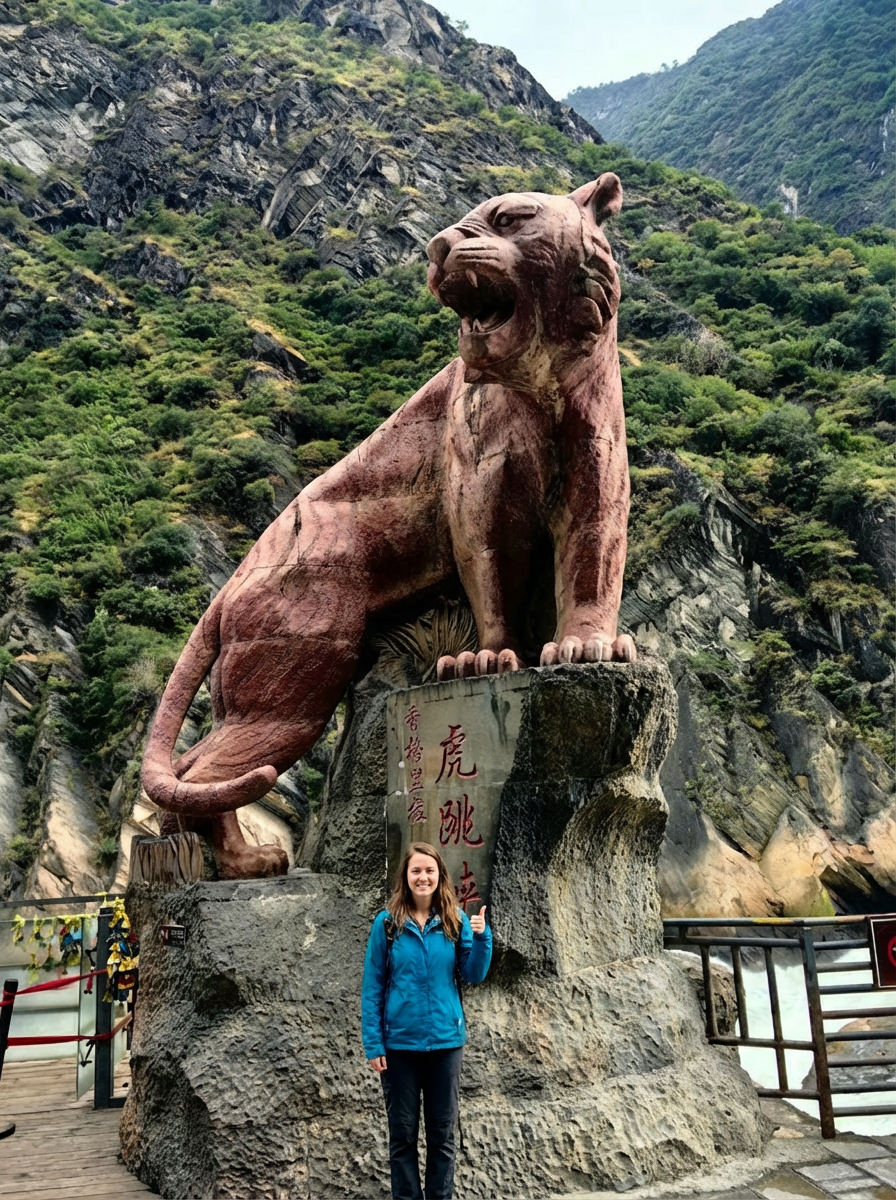
The next morning, I descended towards the Tina’s Guesthouse, which marks the end of the High Trail and the beginning of the descent to the river. This is where the gorge gets its name. Legend has it that a tiger, fleeing from a hunter, leaped across the river at its narrowest point, using a rock in the middle as a stepping stone.
Standing on the viewing platform overlooking the Tiger Leaping Stone, I finally understood the fury of the Jinsha River. Up close, the water is violent. It crashes against the rocks, sending spray high into the air. The noise is deafening, a chaotic symphony of white water. You can feel the vibration of the water in the soles of your shoes. It is a terrifying, awe-inspiring display of raw power. Standing there, looking at that rock, it was easy to imagine the tiger making its desperate, legendary leap.

I spent the afternoon sitting by the water, mesmerized by the flow. It cleared my mind of all the clutter of modern life. There is no WiFi signal down there, just the river and the mountains. It was a detox for the soul.
The trek out was a relief for my knees but a sadness for my heart. Leaving Tiger Leaping Gorge felt like saying goodbye to an old friend. It is a place that demands your respect and your energy, but it gives you back so much more. It taught me that beauty often lies on the other side of difficulty. If you want to see the world from a different perspective, you have to be willing to climb the mountain and walk the edge.