There are waterfalls that are pretty, like bridal veils draped over green cliffs. And then, there is the Hukou Waterfall (Hukou Pubu). This is not a waterfall you look at; it is a waterfall you survive. It is the Yellow River—the Mother River of Chinese civilization—getting angry, squeezing itself through a narrow gorge, and screaming its way down.
I remember standing on the Shaanxi side of the riverbank (the waterfall is shared by Shaanxi and Shanxi provinces). The first thing that hits you isn't the sight; it’s the sound. Long before I saw the water, I heard a low-frequency rumble, like a freight train that never stops coming. The ground beneath my boots actually vibrated. It was a physical sensation, a trembling in the earth that traveled up through my soles and settled in my chest.
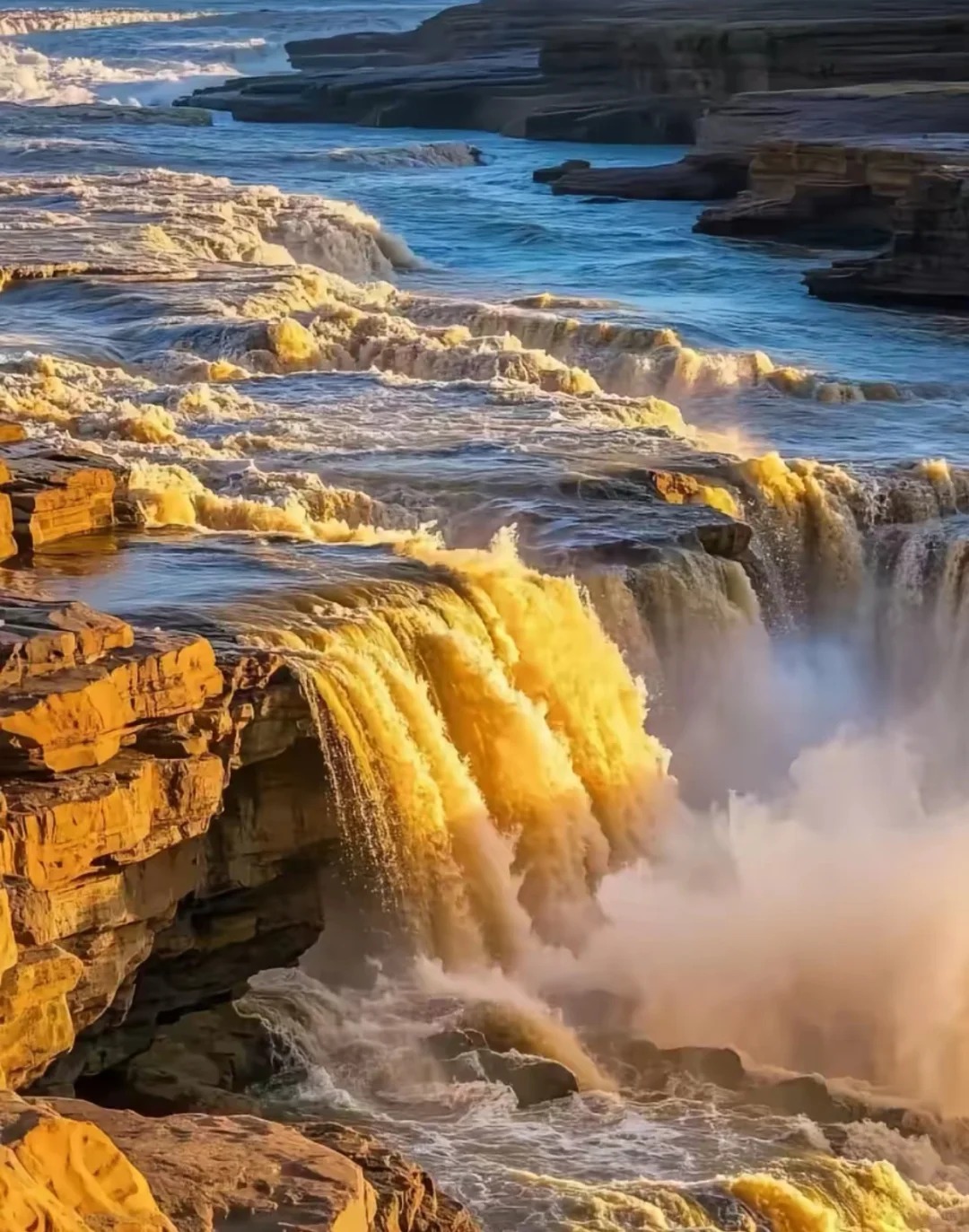
The Golden Dragon
As I walked closer to the edge—protected only by a sturdy metal railing that felt reassuringly thick—the mist began to soak my face. But this wasn't the clean, clear mist of a mountain spring. It was yellow. The air tasted of mud and minerals.
When I finally looked over the edge, my breath hitched. The Yellow River, hundreds of meters wide upstream, is suddenly forced into a channel just 30 to 50 meters wide here. It’s like pouring a bucket of water through a funnel, except the water is a raging, churning slurry of golden mud. The color is unbelievable—a deep, rich ochre, like liquid gold or molten copper.
The locals call it "Ten Thousand Horses Galloping" (Wan Ma Ben Teng), and for once, the hyperbole is an understatement. The water doesn't just fall; it crashes, it explodes. It smashes into the rocks at the bottom, creating a column of mist that rises dozens of meters into the air. Through the mist, I saw a rainbow. But against the backdrop of the muddy water, the rainbow looked surreal, a fragile band of color arching over a scene of violent power.
Below the Waterline
I decided to pay the extra fee to go down to the "Dragon Cave" (Long Dong) viewing platform, which is actually situated below the level of the waterfall. This was a game-changer. Damp, slippery stairs led me down into a cavernous area carved out of the rock. From here, looking up, the perspective was terrifying.
I was staring right into the throat of the beast. The water was thundering down just meters away from my face. I could see the individual waves, the chaotic swirls of mud, the sheer weight of the river. It felt like the water was going to reach out and grab me. I stood there for twenty minutes, mesmerized, unable to look away. My clothes were soaked, my camera lens was spotted with yellow droplets, but I didn't care.
In that moment, I understood why the Yellow River is the soul of China. It’s not gentle. It’s powerful, unpredictable, sometimes dangerous, but endlessly life-giving. It carries the soil of the continent in its veins.
The Drummer on the Shore
Walking back up, I encountered a group of local drummers performing the "Ansai Waist Drum" dance nearby. These were older men, faces weathered by the sun and wind, wearing white towels on their heads. They beat their drums with a ferocity that matched the river. Boom! Boom! Boom! Dust flew from their feet. They leaped and shouted, their movements rough and unpolished but full of raw energy.
Watching them against the backdrop of the roaring waterfall, I realized the landscape shapes the people. You can't be soft when you live next to this river. You have to be loud, you have to be tough, you have to be resilient. The Hukou Waterfall isn't just a geological feature; it’s a mirror reflecting the spirit of the Northwest.
Leaving Hukou, I felt drained but electrified. It’s a place that strips away the pretenses of civilization and leaves you face-to-face with the raw, brutal force of nature. It’s a reminder that we are small, and the river is eternal.