My Personal Chronicle of Shanghai
They call it the "Magic City." Before I arrived, I thought this nickname referred merely to the dazzling lights or the impossible speed of its development. But after spending a week losing myself in its labyrinth of lane houses and craning my neck at its glass giants, I realized the magic lies in its ability to bend time. Shanghai does not just exist in the present; it occupies the past and the future simultaneously.
As a traveler who has walked the ancient walls of Xi'an and drifted down the misty Li River, I expected Shanghai to be just another concrete jungle. I was wrong. This city has a heartbeat, a rhythm that is undeniably sophisticated, unapologetically ambitious, yet surprisingly tender if you know where to look.
Here is the diary of my journey through the streets of Shanghai—a story of soup dumplings, colonial ghosts, and a skyline that defies gravity.

The Bund: Where History Whispers to the Clouds
My journey began where Shanghai began: The Bund.
I made a point to arrive just before dawn. Most tourists swarm this riverside promenade in the evening to see the lights, but to truly understand the soul of Shanghai, you must see it wake up. The air was cool and carried the distinct scent of the Huangpu River—a mix of freshwater, humidity, and the faint, industrial tang of a working harbor.
To my left stood the "glorious yesterday." The 20th-century colonial architecture, a solid wall of granite and stone, glowed in the soft, blue morning light. The Peace Hotel, with its green pyramid roof, looked like a sleeping aristocrat. I ran my hand along the stone railing of the promenade, thinking about the 1920s, when this strip was the "Wall Street of Asia." I could almost hear the jazz trumpets fading out from a bygone era.
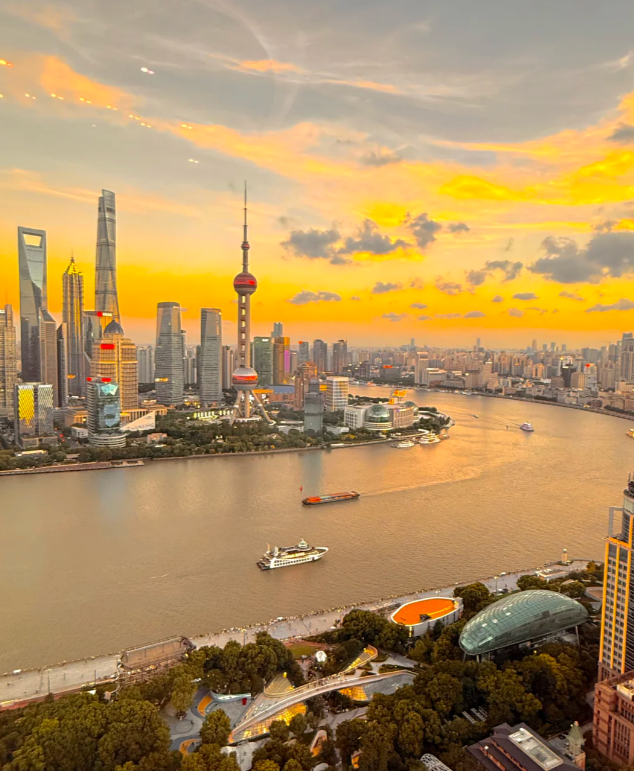
To my right, across the gray waters of the river, stood the "audacious tomorrow." The Lujiazui skyline. It is a view that never fails to shock the system. The Oriental Pearl Tower, with its pink spheres, looked retro-futuristic, like a spaceship from a 1960s sci-fi novel. Beside it, the Shanghai Tower spiraled upward, disappearing into the morning mist like a glass dragon.
As the sun broke the horizon, painting the glass skyscrapers in burning gold, I saw the locals. An elderly man in white silk pajamas practiced Tai Chi, his movements slow and fluid, completely ignoring the futuristic backdrop. A woman walked backward while clapping her hands (a traditional Chinese exercise). This contrast—the hyper-modern backdrop and the slow, traditional life on the ground—struck me deeply. This is the Shanghai paradox.
A Culinary Detour: The Morning Jianbing My stomach grumbled, interrupting my philosophical musings. I wandered a few blocks back from the waterfront into the narrower streets. I was hunting for breakfast. I found a small hole-in-the-wall vendor making Jianbing (a savory crepe).
I watched, mesmerized, as the vendor spread the mung bean batter on the hot circular griddle. Sizzle. He cracked an egg over it, spreading the yolk with a wooden paddle. A sprinkle of scallions, a brush of sweet bean sauce and chili oil, and then the crucial element: the baocui (a crispy fried wonton cracker). He folded it into a neat rectangle and handed it to me hot.
The first bite was a symphony of textures. The soft, eggy crepe, the crunch of the cracker, the salty-sweet depth of the sauce, and the kick of fresh scallions. It cost me less than a cup of coffee, yet it was one of the best meals of my life. Standing there on a street corner, eating a hot pancake while watching luxury cars drive past historic banks, I felt I had truly arrived.
Walking the French Concession: Shadows of Romance and Platanus Trees
If The Bund is Shanghai’s tuxedo, the Former French Concession (FFC) is its silk robe—intimate, elegant, and relaxed.
I spent two full days just walking here. The streets are lined with massive London Plane trees (Platanus), their leaves forming a green cathedral arch over the road. In the summer, they block the sun; in the autumn, they carpet the streets in gold.
I started at the Wukang Mansion (formerly the Normandie Apartments). It sits like a majestic ship at the intersection of five roads. The red brick and French Renaissance style made me feel as though I had been transported to Paris, yet the humid air and the chatter of Shanghainese dialect grounded me in China.
Walking down Wukang Road, I entered a world of "Petit Bourgeois" lifestyle. This is where Shanghai relaxes. The streets are lined with independent coffee shops, boutiques, and art galleries.
The Shikumen Experience: Xintiandi and Tianzifang I ventured deeper to explore the Shikumen architecture—the unique stone-gate houses that define old Shanghai. These houses are a fusion, just like the city itself: Western terraced house layouts with Chinese heavy timber doors and courtyards.
I visited Xintiandi, which is the polished, upscale version of this. It is beautiful, yes, but feels a bit like a movie set. The bricks are too clean; the atmosphere too commercial. I bought an overpriced iced latte and sat by a fountain, watching fashionable young people pose for photos. It was glamorous, but I wanted something grittier.
So, I went to Tianzifang.
This was more like it. A labyrinth of narrow alleyways packed with small shops and studios. It was chaotic and loud. I had to squeeze past other tourists, dodging low-hanging signs and smelling the aroma of perfumes, tea, and frying potatoes.
Deep in one of the alleys, I found a small tea house. I stepped inside to escape the noise. The owner, a woman in a Qipao, brewed me a pot of Longjing (Dragon Well) tea. We sat in silence for a while. "Shanghai is fast," she said to me in English, pouring the pale green liquid. "But here, in the alley, we try to be slow." Sipping the chestnut-scented tea, surrounded by the gray brick walls that have stood for a century, I felt the pulse of the "Old City." It wasn't in the museums; it was in these narrow lanes where neighbors still hang their laundry on bamboo poles out the window, unabashedly displaying their lives to the world.
Yu Garden: Finding Silence in the Chaos
On my third day, I sought the roots of the city. Before the skyscrapers and the colonial banks, there was the walled city.
I headed to the City God Temple area. To be honest, the commercial area surrounding the garden is overwhelming. It is a riot of red lanterns, gold roofs, and souvenir shops selling everything from silk scarves to rubber chickens. The noise was deafening. I almost turned back.
But then, I bought a ticket and stepped through the gates of Yu Garden.
The transition was instant. The noise of the city seemed to be cut off by the high dragon walls. Built during the Ming Dynasty, this garden is a masterclass in the Chinese art of "borrowed scenery."
I walked along the winding paths, which are designed to make the garden feel much larger than it actually is. Every corner revealed a new view: a jagged rockery that looked like a mountain range, a pond filled with fat, golden koi fish, a pavilion with upturned eaves that seemed ready to take flight.
I sat in a pavilion overlooking the Exquisite Jade Rock. I focused on the details: the intricate wood carvings on the window frames, the way the moss grew on the stone paths, the reflection of the willow trees in the water.
The Soup Dumpling Ritual Leaving the garden, I faced the famous zigzag bridge. It is said that evil spirits travel in straight lines, so the nine-turn bridge keeps them away. It also forces you to slow down and look at the lotus pond.
But my destination was the Nanxiang Steamed Bun Restaurant. There was a long line, but as a foodie, I know that a line usually means quality. I waited for thirty minutes to get my basket of Xiao Long Bao (soup dumplings).
Eating these is an art form. I watched a tourist burn his tongue by biting straight into one, splashing hot soup onto his shirt. I mentally shook my head. Amateur.
I picked up a dumpling with my chopsticks, careful not to tear the translucent skin. I placed it on my spoon. Step 1: I bit a tiny hole in the side of the wrapper. Step 2: I blew gently into the hole to cool the broth inside. Step 3: I sucked the rich, savory pork broth out. It was rich, fatty, and incredibly umami. Step 4: I dipped the remaining dumpling in vinegar with ginger shreds and ate it whole.
The contrast of the hot meat, the silky dough, and the sharp vinegar is, in my opinion, the taste of Shanghai. It is delicate yet rich, complex yet simple.
The Heights: Touching the Sky in Lujiazui
After exploring the past, I had to confront the future. I took the ferry across the river to Lujiazui.
Standing at the foot of the Shanghai Tower, I felt like an ant. This is the tallest building in China and the second tallest in the world. It twists as it rises, designed to reduce wind load, but to me, it looked like a strand of DNA stretching into the heavens.
I took the elevator to the observation deck. The speed is terrifyingly fast—18 meters per second. My ears popped. In less than a minute, I was 546 meters above the ground.
Stepping out onto the deck, the city below looked like a circuit board. The massive boats on the river looked like toys. The cars were invisible specks. I saw the shadow of the tower stretching across the city, touching neighborhoods miles away.
It was a cloudy day, and for a moment, a cloud passed right through the building. I was literally standing inside a cloud. It was a surreal, almost spiritual experience. It made me think about human ambition. Thirty years ago, this land I was standing above was mostly farmland and warehouses. Now, it is one of the most powerful financial centers on earth. The sheer force of will required to build this reality is staggering.
However, looking down at the sparkling metropolis, I felt a pang of loneliness. Up here, everything is perfect, silent, and cold. I missed the smell of the Jianbing and the noise of the scooter horns. The view was breathtaking, but the life was down below.
A Sweet Farewell: The Flavor of the Night
For my final night, I wanted a meal that encapsulated the spirit of the city. Shanghai cuisine (Benbang cuisine) is known for being "thick with oil and red sauce" and sweeter than other Chinese cuisines.
I went to a local restaurant that had been recommended by a taxi driver. I ordered the classic: Red Braised Pork (Hong Shao Rou).
When the dish arrived, it glistened like rubies under the warm restaurant lights. The pork belly had been braised for hours in soy sauce, sugar, and wine. I took a piece. The fat melted instantly on my tongue, not greasy, but creamy. The lean meat was tender, and the sauce was a perfect balance of salty and sweet, sticky enough to coat my lips.
I paired it with a bowl of white rice and a plate of stir-fried shepherd's purse (a local green). As I ate, I listened to the table next to me. A large family was celebrating a birthday. They were toasting, laughing, and shouting over each other. The grandmother was sneaking pieces of meat to the grandchild.
It reminded me that despite the futuristic skyline, the colonial history, and the rush of money, the core of Shanghai is still the home. It is a city of people who love to eat, love to dress up, and love their families.
On my way to the airport, taking the Maglev train that levitates magnetically and hits 430 km/h, I watched the scenery blur into a streak of green and gray.
Shanghai is a demanding lover. It is loud, expensive, and exhausting. It overwhelms your senses. But it is also generous. It gives you beauty in the curve of a roof, history in the crack of a pavement stone, and joy in the broth of a dumpling.
I came looking for a tourist spot. I found a living organism.
As my plane took off, I looked down one last time. The city was a galaxy of lights, glowing against the dark earth. I knew I would be back. Because once you have tasted the magic of this city, the rest of the world feels just a little bit slower, a little bit quieter, and a little less flavorful.
This was my Shanghai. And it is waiting to be yours.