They say "Guilin’s scenery is the best under heaven" (Guilin shanshui jia tianxia), a phrase I had heard a thousand times before I ever set foot on this magical land. But no amount of poetry could prepare me for the moment I actually stood there, surrounded by those karst peaks rising abruptly from the ground like jade hairpins dropped by a celestial giant.
As a veteran traveler who has traced the veins of China from the icy north to the tropical south, I invite you to walk with me through my journey in Guilin. This isn't just a sightseeing trip; it is a culinary pilgrimage and a deep dive into a lifestyle so romantic and leisurely, it feels like a dream.
The Arrival – Touching Down in a Painting
The Journey Begins
My journey began with a flight into Guilin Liangjiang International Airport. As the plane descended, I peered out the window. Even from the air, the landscape was distinct—endless clusters of green hills piercing the mist.
Traveler’s Note on Logistics: If you are planning your own escape here, the logistics are surprisingly smooth.
- By Air: Once you land at Liangjiang Airport, you are about 30 kilometers from the city center. I hadn't booked a guide beforehand, so I had a few options. A taxi to the city costs around 100–120 CNY. If you are adventurous and want to save a bit, a ride-share (like Didi) is about 80 CNY.
- Airport Bus: For the solo traveler on a budget, the airport bus is fantastic. It’s only 20 CNY/person to downtown Guilin (approx. 50 minutes). Interestingly, there are also direct buses to Yangshuo (90km away) for 50 CNY/person (approx. 1.5 hours), which is a steal compared to the 220 CNY taxi fare.
- By Train: If you are coming by high-speed rail, pay attention to your station. There are three: Guilin North (Bei), Guilin Station, and Guilin West (Xi). Guilin Station is the most central.
Since my flight arrived in the late afternoon, I followed the golden rule of Guilin travel: If arriving late, stay in Guilin city for the night. I took a taxi, watching the modern highways slowly give way to streets lined with Osmanthus trees.
The First Taste: A City that Smells of Rice
I dropped my bags at my hotel near the Two Rivers and Four Lakes area and immediately headed out. The air here is humid and sweet. My stomach was growling, and there was only one remedy: Guilin Rice Noodles (Mifen).
I found a small, unassuming shop on a side street. This is where the magic happens. I ordered a bowl of "dry mix" noodles. The white, round noodles were buried under a heap of roasted pork, crispy soybeans, pickled cowpeas, and chopped scallions. The secret, however, is in the brine—a dark, savory reduction that smells of star anise and cinnamon. Mixing it all together, the first bite was an explosion of textures: the crunch of the beans, the snap of the pickles, and the silky smoothness of the fresh rice noodles. It was the taste of the city itself—ancient, complex, and humble.
The Heart of the City – History and Waters
A Stroll Through History
The next morning, I dedicated my time to the city's iconic spots. The city attractions are clustered, making them perfect for a leisurely 2-3 day exploration.
My first stop was Jingjiang Princes' City and Solitary Beauty Peak. Walking through the ancient gates, I felt the weight of history. This is one of the best-preserved Ming Dynasty princely residences in China. Climbing the Solitary Beauty Peak (Duxiu Feng) located right in the center was a workout, but the view from the top was unparalleled. The entire city of Guilin lay spread out below, a patchwork of buildings nestled among the jutting karst towers.
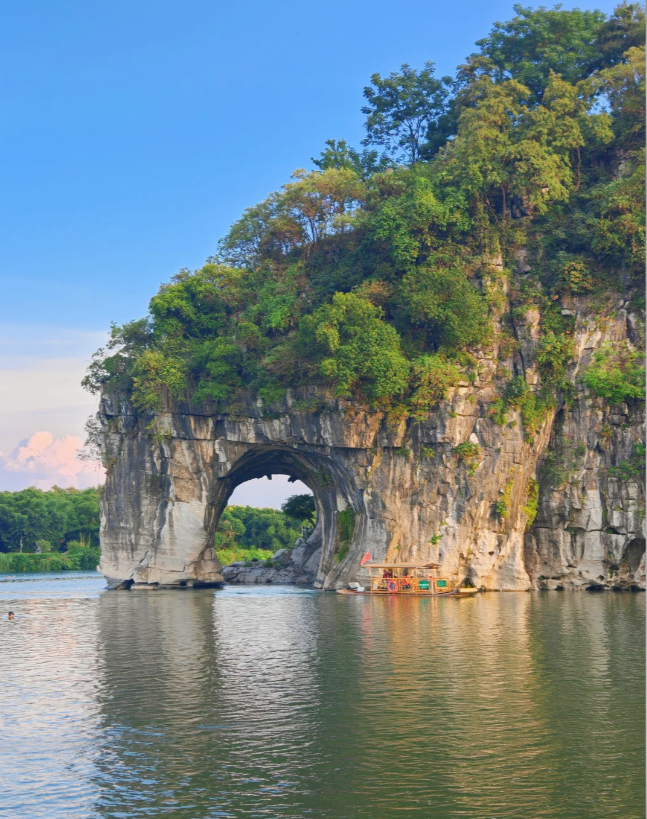
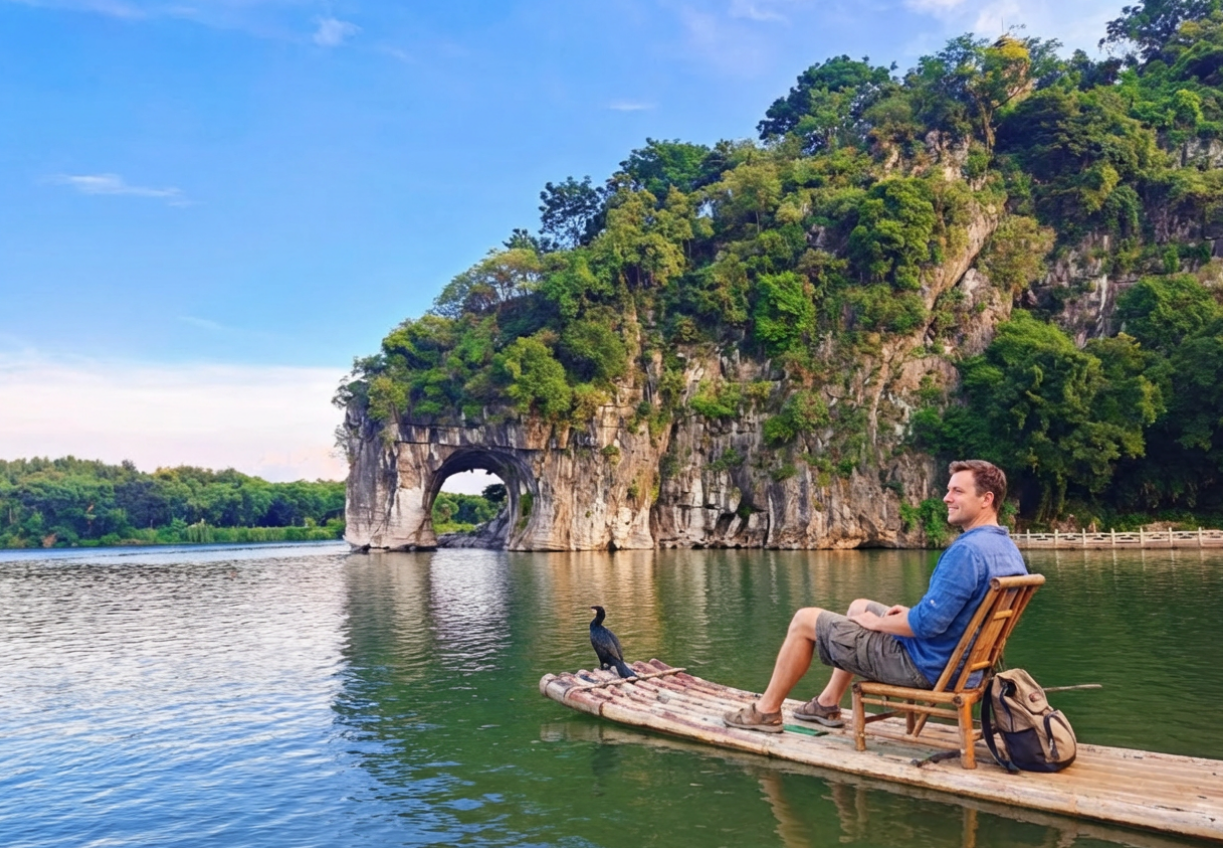
From there, I wandered to Elephant Trunk Hill (Xiangbishan). It really does look like a giant elephant drinking from the Li River! It’s the symbol of the city for a reason. Standing by the riverbank, watching the water flow through the "trunk," I felt a profound sense of peace.
The Urban Pulse: East-West Alley and Pedestrian Streets
For lunch, I headed to East-West Alley (Dongxi Xiang) and Zhengyang Pedestrian Street. These areas are a vibrant mix of old architecture and modern commerce.
- Food Stop: I couldn't resist trying the Spotted Fish Hotpot here. The fish is sliced so thin it’s almost transparent. You dip it in the boiling broth for just three seconds—one, two, three—and it curls up, white and tender. The freshness is undeniable.
As evening fell, the city transformed. I visited the Sun and Moon Pagodas. The Gold (Sun) and Silver (Moon) pagodas shimmered on the water's surface, creating a mesmerizing reflection. I took a cruise on the Two Rivers and Four Lakes. Drifting under stone bridges, illuminated by colorful lights, with the gentle hum of the city in the background, I understood why people say Guilin offers a "romantic and leisurely lifestyle."
The Soul of the Landscape – The Li River & Yangshuo
"The Boat Travels on the River, People Tour in a Painting"
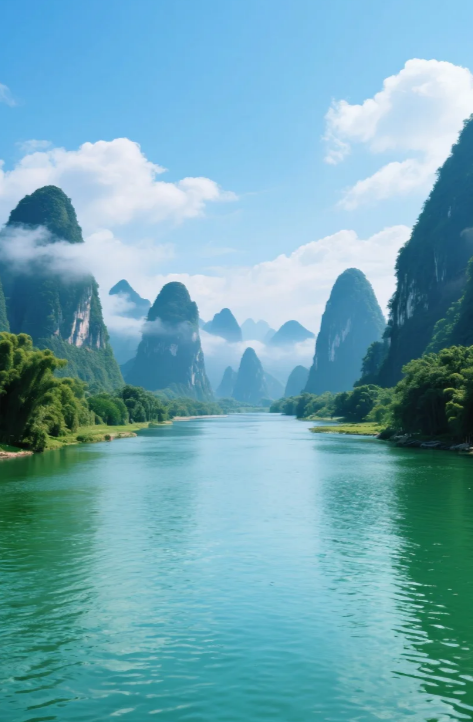
Day three was the highlight: The Li River Cruise. I traveled from Guilin to the Xingping section. This is the "essence" of the Li River, the very scene printed on the back of the 20 CNY banknote.
Boarding a bamboo raft (motorized, but traditional in style), I drifted down the jade-green water. The description "fairyland" is not an exaggeration. The mountains here don't look like mountains elsewhere; they are odd, vertical shapes, named after what they resemble—Nine Horse Fresco, Yellow Cloth Shoal. I saw a fisherman on a narrow raft, his cormorant birds perched stoically on the bamboo pole. It was a living scene from a thousand-year-old scroll painting. The reflection of the peaks in the water was so clear that for a moment, I couldn't tell where the mountain ended and the water began.
Where Days are Lazy and Nights are Wild
I arrived in Yangshuo, a county 90km from Guilin, which feels like the backpacker capital of China. The vibe here is different—more energetic, more international.
Accommodation: I stayed in a boutique hotel near West Street (Xi Jie). West Street at night is a sensory overload in the best way possible. It is "passionate and myriad-styled." Neon lights, thumping music from bars, quiet corners with folk singers, and the aroma of food everywhere.
The Culinary Star: Beer Fish You cannot come to Yangshuo without eating Beer Fish. I sat at a bustling open-air table and ordered the signature dish. A whole carp (caught from the Li River, they claim) is braised in a wok with beer, tomatoes, peppers, and local spices. The fish skin was fried to a crisp, soaking up the rich, tangy, slightly spicy sauce. The meat inside was incredibly tender. It’s a dish that demands rice and good company.
Yulong River & Ten-Mile Gallery
The next day was for the Yulong River. Unlike the grand Li River, the Yulong is intimate. I took a manual bamboo raft—no motors, just the sound of the boatman’s pole pushing against the riverbed. We drifted past ancient bridges and farmers tending their fields.
Later, I rented a bicycle (the best way to see Yangshuo) and rode through the Ten-Mile Gallery. The wind in my hair, the smell of earth and crops, and the backdrop of the Moon Hill... it was pure freedom. I also made a stop at Silver Cave (Yinzi Yan) in Lipu County. The stalactites inside are dazzling, shining like diamonds and silver under the colored lights. The saying goes, "Once you visit Silver Cave, you'll never be short of money." (I’m still waiting for that to kick in, but the view was worth it!)
Evening Spectacle: That night, I watched "Impression Liu Sanjie." It is an open-air performance actually set on the Li River, with the mountains as the backdrop. Hundreds of performers, lights reflecting on the water, and folk songs echoing in the valley. It was majestic and moving, a perfect fusion of nature and culture.
The Dragon’s Backbone – Longji Rice Terraces
For the final leg of my journey, I headed north to Longsheng County to see the Longji Rice Terraces. This is a different world. The climate is cooler, and the landscape shifts from karst peaks to massive, rolling mountains carved into endless steps.
Walking up the terraces was steep, but the view from the "Seven Stars Around the Moon" viewpoint was breathtaking. The paddies were filled with water, acting as thousands of mirrors reflecting the sky.
Here, the culture is dominated by the Zhuang and Yao ethnic minorities. I saw women with incredibly long hair (the Yao women only cut their hair once in their lives).
A Taste of the Mountains: Lunch was in a wooden stilt house. I tried Bamboo Tube Rice (sticky rice and meat roasted inside a fresh bamboo stalk over a fire) and Oil Tea (You Cha). Oil Tea is an acquired taste—it’s like a caffeinated soup made by pounding tea leaves with ginger, garlic, and spices, then boiled. It’s bitter, spicy, and incredibly energizing. The locals say, "One cup is bitter, two are astringent, three are sweet." It warmed me to the bone.

Reflections of a Taste Bud Guide
As I packed my bags to leave, bringing home boxes of Guilin Cakes and vacuum-packed Zongzi (sticky rice dumplings), I reflected on this trip.
Guilin is not just a destination; it is a mood. It is the spiciness of the snails sucked out of the shell at a street stall. It is the freshness of the air while cycling along the Yulong River. It is the awe of seeing a mountain reflected in the water so perfectly that the world seems upside down.
Whether you spend 3 days or a week here, Guilin slows down time. It invites you to stop, look, and taste.
My Recommended Itinerary Summary:
- Duration: 5-6 Days
- Day 1: Arrive in Guilin, City Center, Rice Noodles.
- Day 2: Jingjiang Princes' City, Elephant Trunk Hill, Two Rivers Four Lakes Night Cruise.
- Day 3: Li River Cruise (Guilin to Yangshuo), West Street Nightlife (Beer Fish).
- Day 4: Yangshuo countryside (Yulong River, Ten-Mile Gallery), Silver Cave, Impression Liu Sanjie.
- Day 5: Day trip to Longji Rice Terraces (Bamboo Rice & Oil Tea).
- Day 6: Souvenir shopping and Departure.
Come to Guilin. The mountains are waiting, the water is flowing, and the rice noodles are hot.