Every city has its emblem. For Suzhou, beyond the gardens, it’s Tiger Hill (Huqiu Shan). It’s not a mountain but a large, wooded hill, and it holds a treasure that has defined the city’s skyline for a millennium: the Leaning Cloud Rock Pagoda (Yunyan Si Ta).
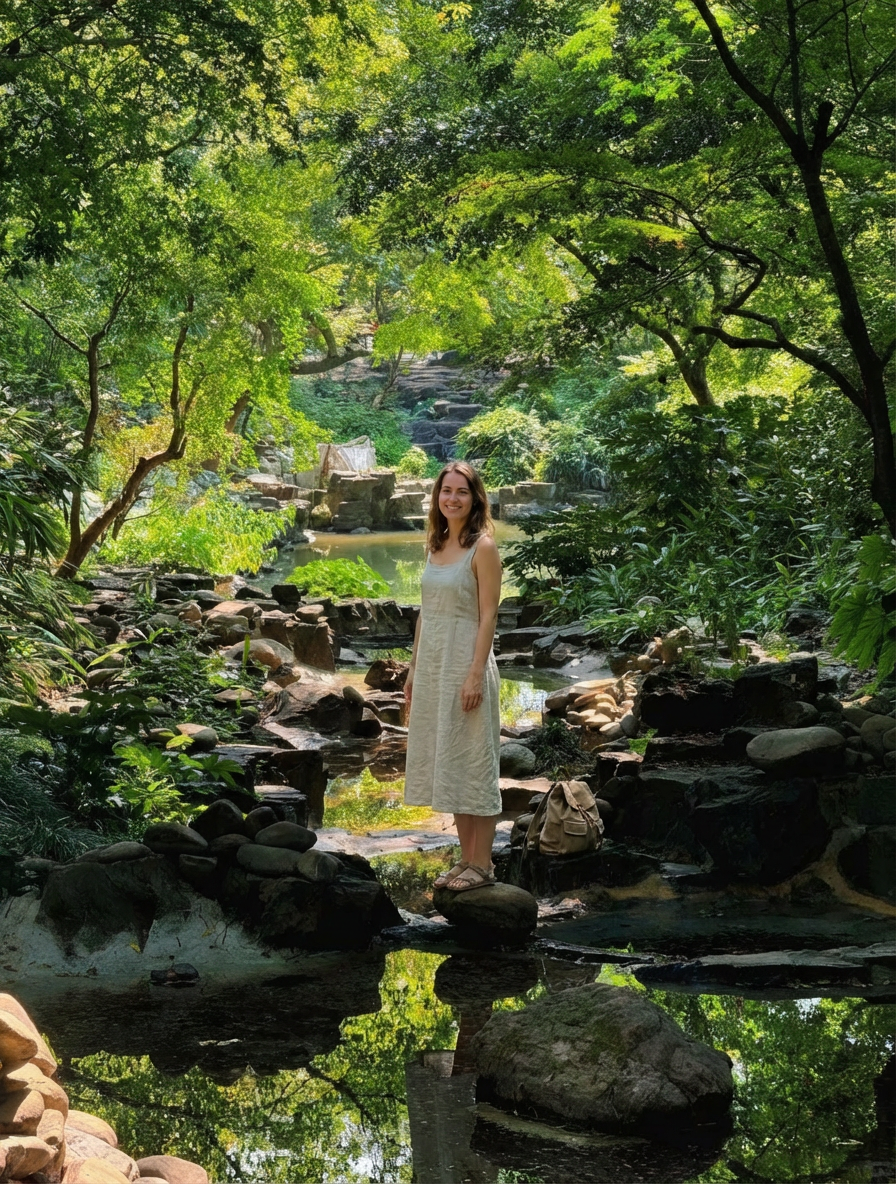
The taxi dropped me at the base, and I walked through the moss-covered “Broken Beam Hall” entrance. The path up was shaded by ancient ginkgo and camphor trees. Despite its fame, the hill had a peaceful, scholarly air. I passed the Sword-Testing Rock and the Tiger Hill Sword Pool, both linked to the tomb of He Lü, the 6th-century BC King of Wu, who is said to be buried here with 3,000 swords. The water was an eerie, opaque green, perfect for legends of sunken treasure.

But the pagoda pulls you upward. As I rounded the final bend, there it was: a seven-story, octagonal brick tower, leaning distinctly—and famously—to the northwest. Completed in 961 AD, it’s China’s answer to Pisa, but older and, to me, more elegant. Its reddish-brown bricks were softened by lichen and time. I stood and stared, trying to separate the optical illusion from the genuine list. It seemed to be frozen in a graceful mid-sway.

I learned its tilt is due to the soft foundation, and centuries of efforts have stabilized it. But its perilous angle is what gives it life, a sense of animate fragility amidst the solid hill. It doesn’t just stand; it poses.
Climbing the hill to its small summit plaza, I found the pagoda’s base cordoned off. You can’t enter, but you can circle it, feeling its monumental presence. From here, views of modern Suzhou spread out, but the pagoda commands all attention. It’s a silent, slanted witness to everything—from the Song Dynasty poets who drank wine here to the tourists of today.

Tiger Hill is a compact anthology of Suzhou’s history: ancient tombs, Tang Dynasty poetry carvings, Song Dynasty architecture, and Qing Dynasty landscaping. But the Leaning Pagoda is its unforgettable protagonist. It’s a lesson in resilience and beauty in imperfection, a symbol that has steadfastly refused to fall, becoming instead the city’s most beloved and crooked smile.