When people talk about a "Great Wall of China tour," they usually mean a quick bus ride, a cable car up, a selfie, and a cable car down. But I wanted something different. I wanted to feel the weight of history under my boots. I wanted to understand why a civilization would spend centuries hauling stones up vertical ridges.
So, I didn’t just "visit" the Wall. I lived with it for a few days. From the wild, crumbling ruins of the untamed sections to the majestic, restored glory of the famous passes, this is the story of my walk along the backbone of the dragon.
The Wild Wall: Battling History at Jiankou
My journey didn't start at a ticket booth. It started in the pre-dawn darkness of a small village called Xizhaizi. I had heard about Jiankou—the "Wild Wall." It hasn't been touched by restorers in hundreds of years. It is dangerous, steep, and utterly mesmerizing.
I hired a local guide, a man named Mr. Chen who had calves like tree trunks and a face weathered by the mountain wind. We started hiking through a thick forest. The air was cool and smelled of damp earth and pine needles. For an hour, there was no wall, just a grueling climb up a dirt path.
Then, the trees broke.
Above me, jagged white dolomite cliffs pierced the sky, and clinging to them, defying gravity, was the Wall. It didn't look like the pictures. Trees were growing out of the watchtowers. The brickwork was shattered, spilling down the slopes like broken teeth.
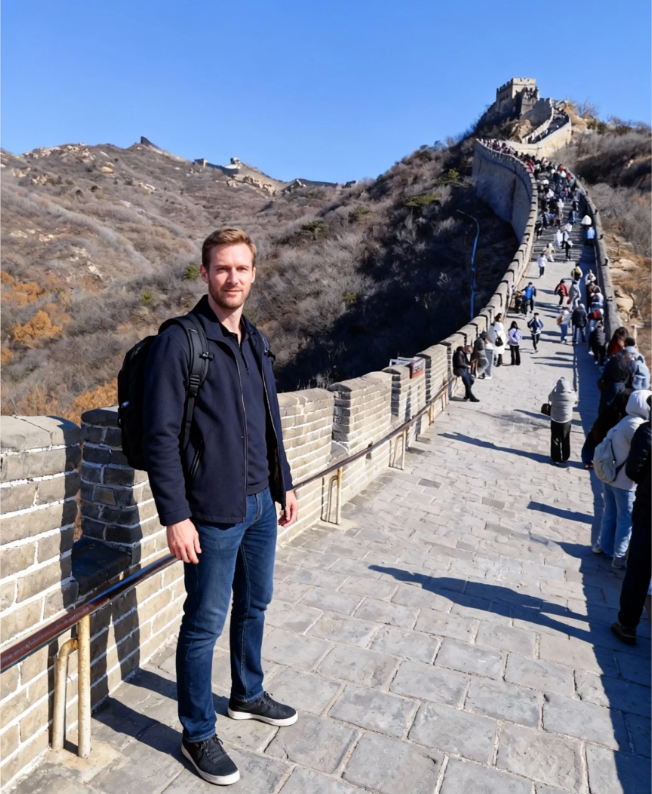
Climbing Jiankou is not a hike; it’s a scramble. At one point, I was on all fours, gripping loose bricks, pulling myself up a section known as the "Sky Ladder." It was terrifying. My heart hammered against my ribs—partly from exertion, mostly from the sheer drop on either side. But when I pulled myself onto the crumbling floor of a watchtower named "The Eagle Flies Facing Upward," fear vanished.
The view was primal. The Wall stretched endlessly, a pale grey ribbon undulating over green peaks that faded into blue haze. There were no tour groups here. No loudspeakers. Just the sound of the wind rushing through the arrow slits. I sat on a broken stone, drinking water that tasted like the best champagne. I touched the mortar. It was rough, gritty. Someone laid this brick during the Ming Dynasty, sweating, perhaps scared, looking out at these same mountains. In the silence of Jiankou, I felt a profound connection to those forgotten builders. It wasn't just a fortification; it was a graveyard of effort and a monument to human stubbornness.
The Transition: A Sunset Walk to Mutianyu
Instead of descending, we hiked east. The plan was to walk from the wild Jiankou section into the restored Mutianyu section. This transition was fascinating. It was like walking through time, watching the Wall heal itself.
As the afternoon wore on, the scrub brush and loose stones began to disappear. The path leveled out. The bricks became square and whole again. We were entering Mutianyu.
The sun was beginning to dip, casting long, golden shadows across the crenelations. Most of the day-trippers had already left. It was quiet, but a different kind of quiet than Jiankou. It was the quiet of a grand empty hall.
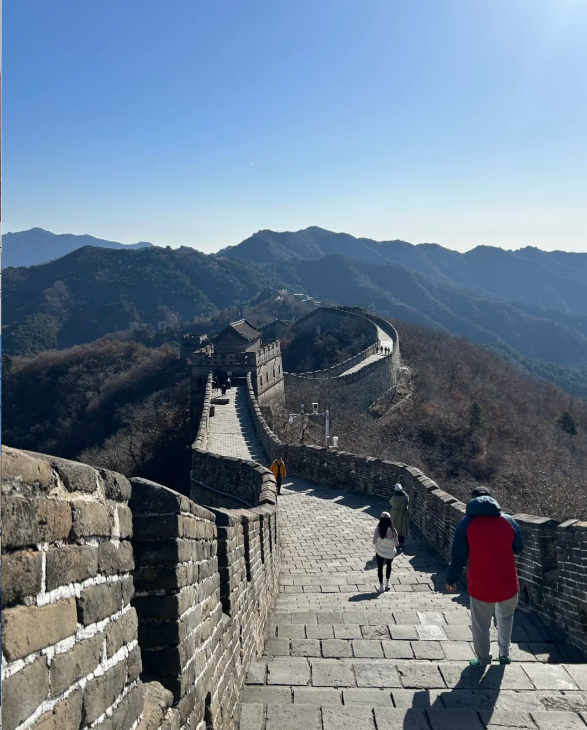
I remember walking along a particularly wide stretch. The battlements here were pristine. I ran my hand along the smooth stone parapets. You could see the military genius of it here—the spacing of the watchtowers, the angles designed for crossfire. It felt impregnable.
I watched the sunset from Watchtower 14. The sky turned a bruised purple and burnt orange. The Wall glowed. It looked like a golden snake resting on the velvet green hills. I stood there until the light faded, feeling the temperature drop rapidly. It was a moment of pure peace. I realized that while Jiankou showed me the Wall's struggle against nature, Mutianyu showed me its triumph. It was beautiful, not in a delicate way, but in a powerful, enduring way.
Gubeikou: The War-Torn Gateway
The next day, I traveled further northeast to Gubeikou. If Jiankou is about scenery, Gubeikou is about war. This was a vital pass, the site of over 130 battles throughout history.
The Wall here felt different. It was rougher, more battered, not by time, but by violence. I walked along the "Panlong" (Coiling Dragon) section. The path was essentially an earth ridge, the bricks long gone or buried.
I stopped at a spot where a local farmer was selling water. He pointed to a hole in a nearby tower. "Japanese shell," he said in broken English, mimicking an explosion with his hands. "1933."
It hit me then that this wasn't just ancient history. Men fought and died here less than a century ago. I looked out at the rolling hills of the Mongolian borderlands beyond. It looked so serene now, covered in wildflowers—yellows and purples swaying in the breeze. It was hard to imagine the screams, the smoke, the arrows, and the bullets.
I walked for miles that day, the path winding through tall grass that brushed against my waist. I passed a 24-window watchtower, a rarity. Inside, it was cool and shadowy. I sat in one of the arched windows, framing the landscape like a painting. I thought about the soldiers stationed here. Did they admire the view? Or did they only see the threat hiding in the valleys? Gubeikou felt melancholy to me. It was a reminder that this beautiful structure was born out of fear—the fear of what lay beyond the horizon.
Jinshanling: The Photographer’s Dream
My final stop was Jinshanling. Everyone told me, "If you want to see the Wall at its most photogenic, go to Jinshanling." They were right.
I arrived in the late afternoon, planning to stay for the sunset and rise for the sunrise. I stayed at a small guesthouse at the foot of the mountain. The owner, a jovial woman who kept piling more rice into my bowl, told me, "Tomorrow, you wake up early. 4:00 AM. You will see the magic."
She wasn't lying.
Hiking up in the dark was eerie. My headlamp cut a narrow beam through the blackness. But as I reached the ridge, the sky began to bleed into a soft indigo.

And then, the show began.
As the sun crested the horizon, the Wall ignited. Jinshanling is famous for its density of watchtowers and its steep gradients. The light hit the eastern faces of the towers, turning them a brilliant copper, while the western sides remained in deep blue shadow.
I set up my camera, but mostly, I just stared. The "Sea of Clouds" phenomenon happened that morning. Thick, white mist filled the valleys below, isolating the peaks so the Wall looked like it was floating in the sky. It was ethereal.
I walked the ridge for hours as the sun climbed. The architecture here is stunning—some towers are square, some round, some oval. There are barrier walls, shooting holes, and obstacle walls. It’s a complex defense system that happens to be visually spectacular.
I met an old photographer on the trail. We didn't share a language, but we shared a moment. He pointed to a steep section ahead, gave a thumbs up, and patted his heart. I understood. It’s a workout, but it’s worth it for the soul.
Reflections from the Ridge
Leaving the Great Wall was harder than I expected.
On the bus ride back to Beijing, I looked at my photos. They were beautiful, sure. But they couldn't capture the smell of the pine resin at Jiankou, the silence of the Gubeikou battlefields, or the burning in my legs after climbing thousands of steps at Jinshanling.
A Great Wall of China tour isn't just about seeing a landmark. It’s about physical contact with history. It’s about realizing that humans are capable of impossible things.
I closed my eyes and I could still see it—that grey line stretching on forever, over the mountains, into the distance. It’s a sight that stays with you, etched into your memory like the carvings on the stones. If you go, don't just look at it. Climb it. Sweat on it. Touch it. Let the Dragon tell you its story.