I’d heard Jiuhua Mountain called “the most compassionate mountain in China” long before I visited, and I was curious to see what that meant. The journey to Jiuhua started with a train ride to Chizhou City, where the air already felt different—cleaner, calmer. Then a bus took me up the winding mountain roads, the trees getting denser, the houses getting smaller, until finally, the mountain came into view: 99 peaks rising through the mist, like something out of a fairy tale.

Jiuhua Mountain, one of China’s four great Buddhist mountains, gets its name from its nine lotus-shaped peaks. It’s been a sacred place for Buddhists for over a thousand years, and everywhere you look, there are signs of that spirituality—temples with golden roofs, stone shrines, and monks in orange robes walking slowly, their heads bowed. My first stop was the Corporeal Body Temple, a small, quiet temple that holds the incorruptible body of Monk Jin Qiaojue, believed to be the incarnation of Ksitigarbha Bodhisattva. The body is displayed in a glass case, dressed in a red robe, and as I looked at it, I felt a sense of awe. It’s been intact for over a thousand years, through wars, storms, and time. A monk explained that the body is a symbol of Ksitigarbha’s vow to save all sentient beings. “He’s still here, watching over us,” he said.
Huacheng Temple, the oldest and largest temple on Jiuhua, was next. It was built during the Eastern Jin Dynasty, over 1,600 years ago, and walking through its courtyards felt like stepping back in time. The wooden beams are carved with dragons and phoenixes, their colors faded but still vibrant, and the walls are covered with murals depicting Buddhist stories. I spent an hour wandering the temple, stopping to look at the murals and listen to the monks chanting. In one courtyard, there was a small garden with a lotus pond, and I sat on a stone bench there, watching the lotus flowers float on the water. A group of children from a nearby village were visiting the temple with their teacher, and they laughed as they ran around the courtyard, their voices mixing with the chanting. It was a beautiful contrast—old and new, sacred and playful.
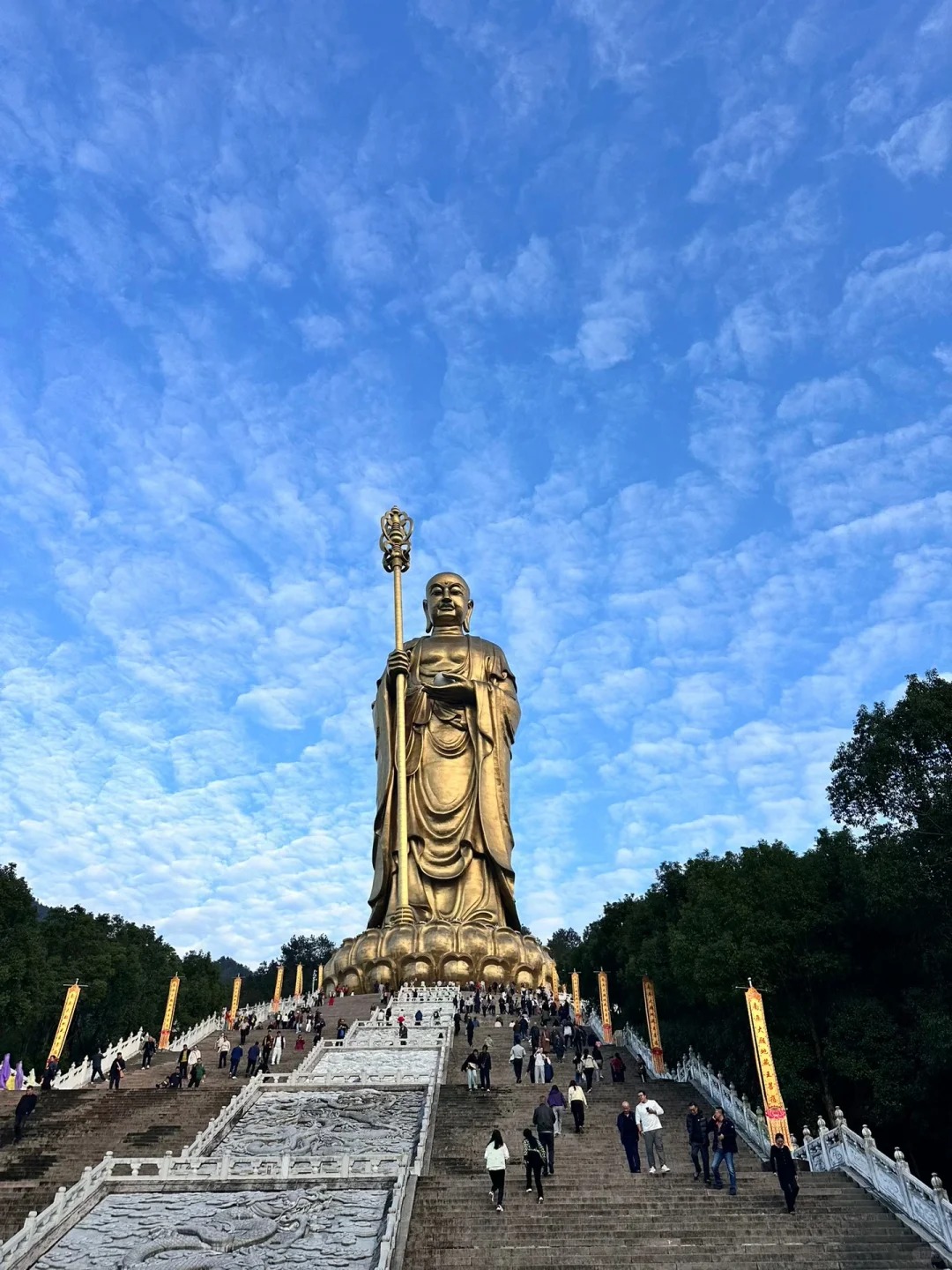
Climbing Tianzhu Peak, the highest peak on Jiuhua, was the hardest part of my trip, but also the most rewarding. The trail was steep, with stone steps that seemed to go on forever, and by the time I was halfway up, my legs were shaking. But I kept going, stopping every now and then to catch my breath and admire the views. Along the way, I passed waterfalls that sparkled in the sunlight, streams that gurgled over smooth stones, and bamboo forests that rustled in the wind. When I finally reached the top, I fell onto a rock and looked out. The entire mountain was spread out below me—green peaks, misty valleys, temples like tiny dots. I pulled out a snack I’d brought—a rice cake from a local stall—and ate it slowly, savoring the moment. A man from Guangzhou sat down next to me and offered me a sip of his tea. “First time here?” he asked. I nodded. “You picked a good day,” he said. “The weather’s perfect.”
Jiuhua’s flora and fauna surprised me. I saw azaleas in bright pink and red, blooming along the trail, and rhododendrons that smelled like honey. I even spotted a small Chinese giant salamander in a stream, its gray body blending in with the rocks. A local guide told me that Jiuhua is home to over 1,400 species of plants and 200 species of animals, many of which are rare and endangered. “The mountain takes care of them,” he said. “And they take care of the mountain.” It made me think about how connected everything is here—nature, culture, spirituality.

That night, I stayed in a family-run guesthouse at the foot of the mountain. The family was warm and welcoming, and the mother cooked me a delicious dinner of bamboo shoot soup and braised mushrooms. The soup was light and flavorful, with bamboo shoots that tasted like spring, and the mushrooms were rich and earthy. We sat around a wooden table, and the father told me stories about Jiuhua—about pilgrims who walk from hundreds of kilometers away to visit the mountain, about monks who meditate in caves for years, about the time a storm hit the mountain but the Welcoming Pine survived. I listened, fascinated, as the fire crackled in the fireplace.
The next day, I visited the Jiuhua Mountain Museum, which told the story of the mountain from its Taoist roots to its status as a Buddhist center. There were ancient Buddhist scriptures written on bamboo strips, statues of Buddha made of bronze and jade, and paintings of the mountain from different dynasties. One exhibit was about Monk Jin Qiaojue, showing his journey from Korea to Jiuhua and how he spent his life helping the poor and spreading Buddhism. It was a moving exhibit, and it helped me understand why Jiuhua is such a sacred place.
Before I left, I walked around the mountain village at the foot of Jiuhua. The village is small, with narrow lanes and traditional Chinese houses with black tiles and white walls. The locals were busy with their daily lives—old women sitting on doorsteps chatting, men working in the fields, children playing with a dog. I stopped at a small market and bought a hand-carved wooden Buddha statue and a bag of local tea. The vendor, an old man with a white beard, told me to “come back soon.” “The mountain always welcomes friends,” he said.
As the bus pulled away from Jiuhua Mountain, I looked back at the peaks, now hidden in mist. I felt a sense of gratitude—for the beauty I’d seen, for the kindness of the people I’d met, for the peace I’d found. Jiuhua isn’t just a mountain; it’s a feeling of compassion, of connection, of hope. It’s the kind of place that makes you believe in something bigger than yourself. And I know I’ll be back, to walk its trails again, to listen to its chants, to feel its warmth.