They told me to see Guilin. They showed me pictures – those impossible, pointed mountains rising from misty rivers like teeth from a sleeping dragon’s jaw. I thought I knew what to expect. I was wrong. No photograph breathes. No postcard holds the scent of wet limestone and frying chili. This is the story of my days in a landscape that feels less like geography and more like a gentle, persistent dream.
Part 1: Dawn on the Li River – The World in Monochrome and Hush
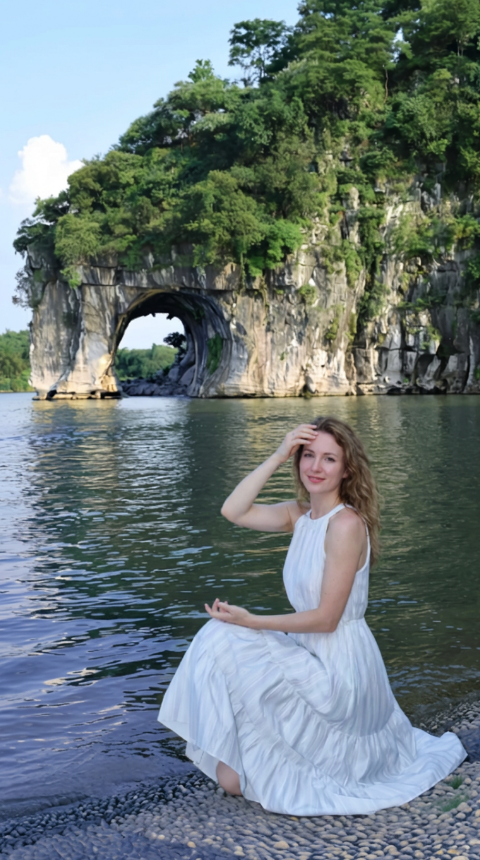
My journey began in the profound silence of a pre-dawn. I found myself on a simple, weathered wooden boat at a sleepy pier in Zhujiang Town, the air so cool and damp it felt like a thin sheet of silk against my skin. The famous Li River was not yet a spectacle; it was a secret, a ribbon of dark, glassy ink flowing between immense, shadowy forms.
As the first light seeped into the sky, the world materialized in layers of gray. Those iconic karst peaks weren’t suddenly “there.” They emerged, shyly, from the fading night, their outlines softening from deep charcoal to misty blue. The famous “view from the 20-yuan note” was just another curve in the river here, real and unposed. The only sounds were the soft chug of our boat’s engine, the lap of water against its sides, and the distant, haunting call of a cormorant fisherman to his birds. I saw them then – a few slender boats, the fishermen’s iconic lamps glowing like fallen stars on the water, their trained birds diving silently. It wasn’t a performance; it was a fragile, fading page from a very old life, played out in the morning hush. I felt like an intruder in the best possible way, privileged to witness a world waking up on its own ancient terms. The grandeur wasn’t loud; it was a whispered secret shared between the river, the mountains, and the slowly brightening sky.
Part 2: Two Wheels and a World of Green – Yangshuo’s Backyard
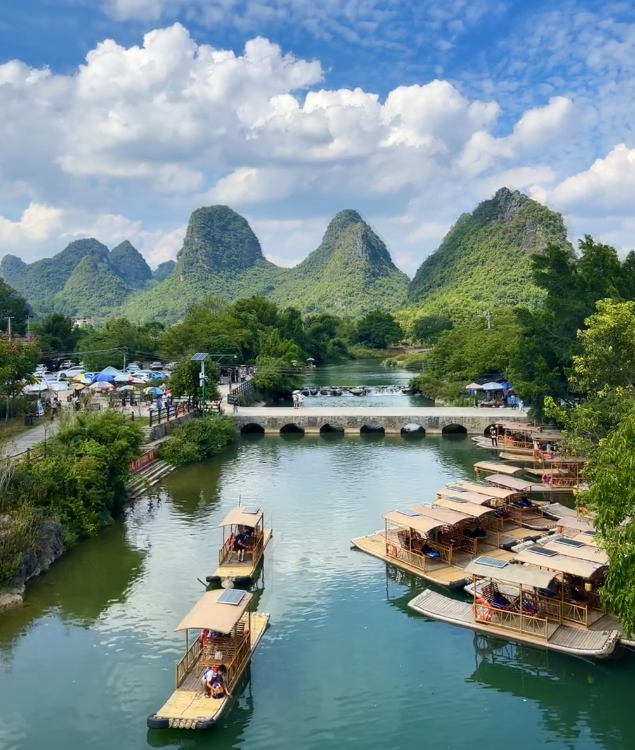
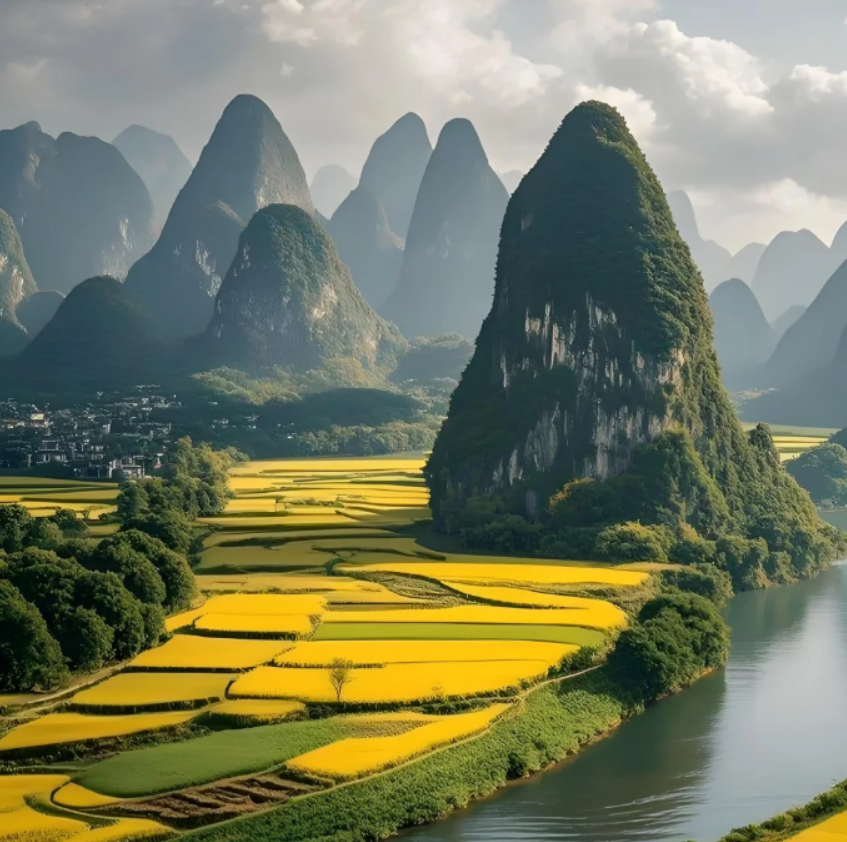
After the solemn poetry of the river, I craved land and motion. In Yangshuo, I rented a clunky, utterly reliable bicycle. Leaving the buzz of West Street behind, I pedaled into a painting that rolled on forever. A narrow concrete path led me through a tapestry of green so vibrant it hummed. Emerald rice paddies, precise as checkerboards, reflected the jagged peaks. I passed through tiny villages where old men played checkers under banyan trees and the air smelled of woodsmoke and ripe guava.
I got gloriously, happily lost. One path led me to the Yulong River, a quieter, gentler cousin of the Li. Here, I abandoned my bike and took a bamboo raft poled by a man with a face etched by sun and smiles. The water was so clear I could see schools of tiny fish darting between the weeds. We floated under ancient stone bridges, their mossy backs stories in themselves. Children waved from the banks. The pace was the pace of the current – slow, inevitable, peaceful. This was the Guilin beyond the postcard. It was tactile and alive: the burn in my thighs from pedaling, the cool spray from the river, the taste of a freshly peeled pomelo bought from a roadside stand. This landscape wasn’t just to be viewed; it was to be moved through, sweated in, and absorbed through your pores.
Part 3: The Mountain’s Heart – A Cave Called Reed Flute
I had to know what was inside those mysterious hills. Reed Flute Cave provided the surreal answer. Stepping from the humid day into the cave’s cool, dark belly was like stepping into another planet’s cathedral. The air smelled of deep earth and minerals. Then the colored lights came on, and the chamber exploded into a silent, subterranean fireworks display.
Stalactites and stalagmites, formed over millennia, dripped from the ceiling and rose from the floor in fantastical shapes. With the dramatic lighting, they became “The Dragon Pagoda,” “Crystal Palace,” and a stunning “Sky-Scraping Twin.” It was kitschy and magnificent all at once. Running my hand over a smooth, cool flowstone wall, I felt a dizzying sense of time. Each droplet that formed this beauty took centuries. My entire life was less than a blink here. The cave was a beautiful, humbling reminder that the true artistry of this place operates on a clock we can hardly comprehend.
Part 4: Sunset from Above – Climbing Xianggong Hill
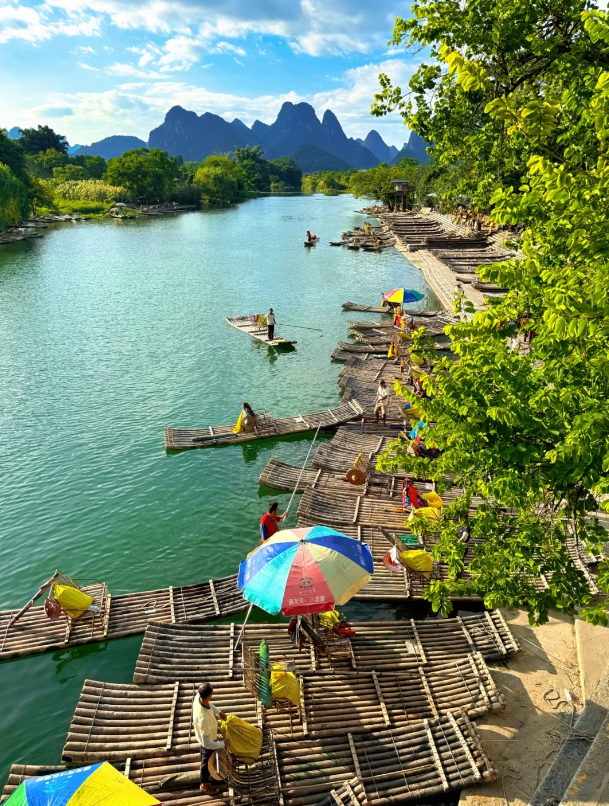
For our final act, my local friend insisted on a climb. “Not for the view you know,” he said, “for the view you feel.” Xianggong Hill, about an hour from Yangshuo, is a steep but short hike. As I reached the summit, sweating and breathless, the world fell away.
Before me, the Li River performed its most breathtaking ballet. It coiled in a vast, sweeping ‘U’ around a forest of karst peaks that stretched to the horizon. The late afternoon sun, low and honeyed, painted everything in gold and deep shadow. This was the panoramic payoff. Tourists murmured in a dozen languages, but the scale of the vista swallowed the sound. I felt incredibly small, yet connected. This was the iconic Guilin, yes, but seen from the shoulder of a giant. As the sun dipped, turning the river to liquid copper, I didn’t just see a beautiful scene. I felt the quiet culmination of my journey – the intimate dawn, the lively exploration, the deep-time wonder of the cave, all leading to this majestic, silent goodbye from the world’s most graceful mountains.
Part 5: The Taste of Memory – A Noodle-Fueled Epilogue
You cannot talk about Guilin with your soul alone; your stomach must be part of the conversation. And in Guilin, that conversation is built on rice noodles. *Guilin Mifen*. I had my first bowl in a noisy, fluorescent-lit shop where locals slurped with focused joy. The broth, simmered for hours with pork bones and secret spices, was savory, aromatic, with a subtle heat that built with each bite. The springy rice noodles, the crunchy peanuts, the pickled beans, the slice of braised pork – it was a symphony of texture and warmth. I had it for breakfast, after a long bike ride, as a late-night snack. It was the hearty, unpretentious fuel of this place. That simple bowl, more than anything, tastes like Guilin to me now – complex, comforting, deeply satisfying, and wonderfully, unforgettably real.
A Final Thought, Carried Home
Guilin teaches you a different way of seeing. It’s not about conquering a peak, but about listening to a valley. It’s about the cool touch of a cave wall that remembers dinosaurs, the sound of a bamboo pole dipping into a quiet river, the smell of rain on a rice paddy with a mountain shadow falling across it. It’s a landscape that cradles you in its timeless, poetic embrace. My photos can show you the shapes, but they can’t give you the feeling – the feeling that you have, for a few brief days, lived inside a Chinese watercolor that somehow learned to breathe, to feed you, and to change you, just a little, forever.