A Day with Giants: My Journey at Chengdu Research Base of Giant Panda Breeding
I woke up to the sound of rain tapping on my hotel window in Chengdu, and for a split second, my heart sank. I’d planned this trip to the Chengdu Research Base of Giant Panda Breeding for months—had even timed it for early spring, when the weather is supposed to be mild and the bamboo shoots are fresh. But as I pulled back the curtain, I saw not just rain, but a soft, misty drizzle that wrapped the city in a gentle haze. “Good for the pandas,” the hotel concierge said when I mentioned my worry over breakfast. “They love cool, damp days. And fewer crowds, too.” His smile was reassuring, so I grabbed my umbrella, slung my camera over my shoulder, and headed out into the Chengdu morning—wet, warm, and full of the faint scent of Sichuan peppercorn from a nearby street stall.

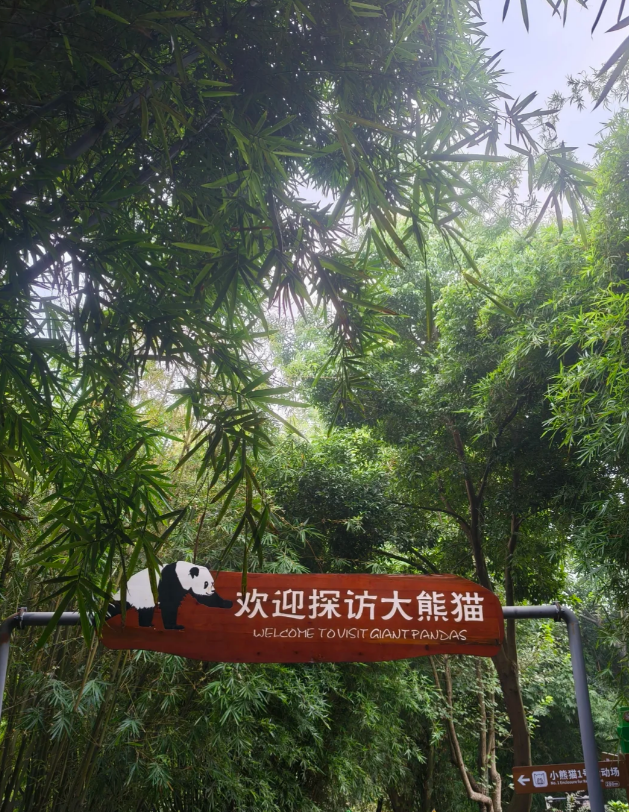
The taxi dropped me off at the main entrance just after 8 a.m., and he was right—there were only a handful of other visitors, most of them locals with strollers or photographers with big lenses. The air smelled like fresh bamboo and damp earth, a welcome change from the city’s busy streets. As I walked through the entrance gate, I passed a large sign with a map of the base and a quote from Jane Goodall: “What you do makes a difference, and you have to decide what kind of difference you want to make.” I paused to read it, and it hit me—this wasn’t just a zoo. This was a research center, a conservation hub, a place where people were working tirelessly to save a species that once teetered on the brink of extinction. That thought gave my visit a weight I hadn’t expected, turning excitement into something deeper, more meaningful.
Chapter 1: Morning Feeding – Pandas in Their Element
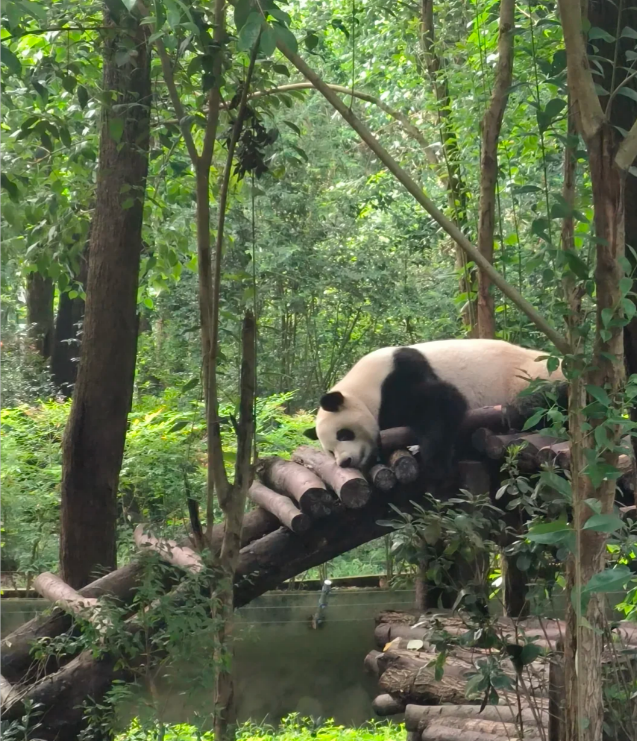
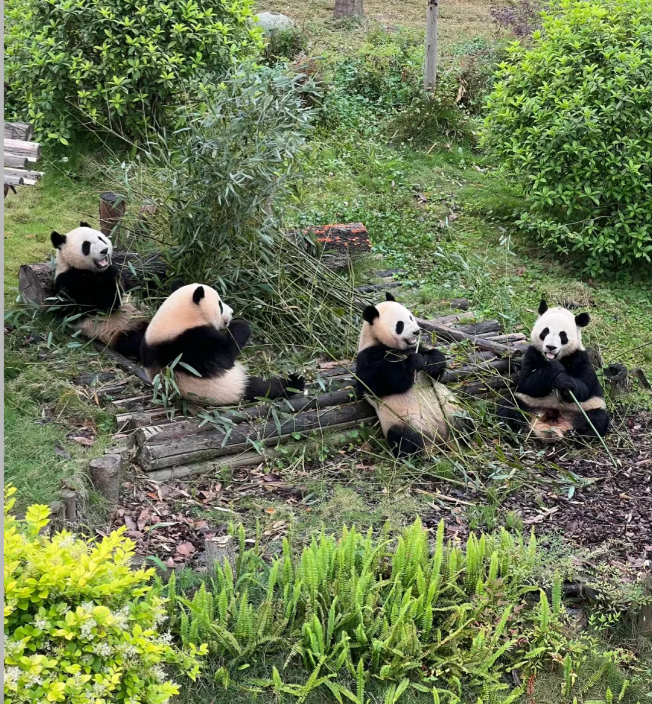
The first stop on every panda lover’s itinerary is the Adult Panda Enclosure, and I followed the crowd (small as it was) along a paved path lined with bamboo. The mist was still thick, hanging in the air like a white blanket, and as I rounded a bend, I heard it—the soft, crunching sound that would become the soundtrack of my day. There, sitting on a wooden platform under a grove of bamboo, was a giant panda, its black-and-white fur glistening slightly from the rain, munching on a bamboo stalk with utter concentration. It didn’t look up when we approached, didn’t seem to care about the cameras clicking or the quiet whispers of visitors. It was just… eating. Slowly, deliberately, savoring every bite.
I leaned against the wooden railing, my umbrella propped against my shoulder, and watched. The panda’s paws were surprisingly dexterous—它 wrapped one around the bamboo stalk, used its sharp teeth to strip off the leaves, then bit into the tender core with a crunch that echoed through the enclosure. Every now and then, it would pause, lick its paw, and then reach for another stalk, as if debating which one to choose next. A zookeeper walked by, carrying a bucket of bamboo, and I asked her how much they eat in a day. “Up to 30 kilograms,” she said, grinning. “They spend 12 to 14 hours a day eating—rest of the time is sleeping. It’s a tough life, right?” Her joke made me laugh, but as I watched the panda, I realized there was something almost meditative about its routine. No hurry, no stress—just the simple act of eating, of being alive.
A little further along the path, there was another enclosure with two pandas playing. Well, “playing” might be a stretch—one was lying on its back, kicking its legs in the air, while the other was trying to climb on top of it, both of them making soft, grunting sounds that sounded like happy sighs. A group of children laughed nearby, pointing and yelling “Panda! Panda!” but the pandas didn’t even flinch. They were in their own world, a world of bamboo and play and naps. I took a photo, but quickly put my camera away—some moments are better experienced than captured. I wanted to remember the way the smaller panda rolled off the larger one, landed with a soft thud on the grass, and then immediately rolled over to munch on a nearby bamboo stalk as if nothing had happened.
As the mist began to lift around 10 a.m., I wandered over to the Feeding Demonstration Area, where a zookeeper was explaining how the base prepares food for the pandas. She held up a bamboo stalk and pointed out the different parts—“The leaves are high in fiber, the core is high in sugar”—and then showed us a bucket of “panda cake,” a special mixture of bamboo powder, honey, and vitamins that’s used as a treat. “We don’t give it to them every day,” she said. “It’s like candy for kids.” A few minutes later, a panda ambled over to the fence, its belly already slightly rounded from breakfast, and looked up at the zookeeper with what seemed like expectation. She tossed it a panda cake, and it caught it in one paw, then sat down to eat it slowly, its eyes half-closed in delight. The crowd cooed, and I found myself smiling like an idiot. There’s something about watching a giant panda eat a treat that’s impossible to resist—it’s pure, uncomplicated joy.
Chapter 2: The Panda Nursery – Tiny Wonders and Big Hopes
By mid-morning, the rain had stopped, and the sun was starting to peek through the clouds, casting golden light on the bamboo forests. I made my way to the Panda Nursery, which is tucked away in a quieter part of the base, and as soon as I walked in, I was hit by a wave of warmth—both from the heated rooms and from the sheer cuteness of what was inside. Through large glass windows, I could see several panda cubs, each no bigger than a small dog, curled up in soft blankets or crawling around on wooden play mats.
One cub was trying to climb a small wooden slide, its tiny paws slipping on the smooth surface. It would climb a few inches, slide back down, and then try again, grunting with determination. A zookeeper stood nearby, watching, but not interfering—“We let them learn on their own,” she explained to a group of visitors. “It helps them build strength for when they’re older.” After three tries, the cub finally made it to the top of the slide, paused for a moment as if celebrating, then slid down with a squeal that sounded like a baby’s laugh. The entire room erupted in applause, and even the zookeeper smiled.
I stayed at the nursery for over an hour, watching the cubs sleep, play, and nurse from their mothers (or from zookeepers, for the ones who’d been abandoned). One mother panda lay on her back, holding her cub close to her chest, licking its fur gently. The cub nuzzled into her belly, then lifted its head and looked directly at me, its black eyes wide and curious. For a second, our eyes met, and I felt a jolt—this was a living, breathing creature, not just a symbol or a photo opportunity. It had a personality, a will, a life that mattered.
A guide at the nursery noticed me watching and came over to talk. Her name was Mei, and she’d worked at the base for 15 years. “When I first started, there were only about 100 giant pandas in captivity worldwide,” she said. “Now, thanks to places like this, there are over 600. We’ve even reintroduced some to the wild.” She pointed to a photo on the wall of a panda being released into a forest in Sichuan. “That’s Xiao Li,” she said. “We tracked her for two years—she had two cubs in the wild. That’s the goal, you know? To get them back where they belong.” Her voice was filled with pride, and I could see why. This wasn’t just a job for her; it was a mission.
As I left the nursery, I passed a wall covered in photos and stories of pandas that had been born or rescued at the base. There was a photo of a cub named Yuan Yuan, who’d been found abandoned in the wild as a baby, weighing only 500 grams. Now, she was 10 years old and had three cubs of her own. Another photo showed a group of pandas being loaded onto a plane bound for a zoo in France—“scientific cooperation,” the caption said. It struck me that the base wasn’t just about conservation; it was about connection. Pandas were a bridge between China and the rest of the world, a shared symbol of hope that we could work together to save the planet’s most vulnerable creatures.
Chapter 3: Beyond Pandas – The Base’s Hidden Gems
By noon, I was hungry and tired, so I headed to the base’s bamboo-themed restaurant for lunch. I ordered a bowl of bamboo shoot noodles and a plate of spicy tofu—classic Sichuan dishes—and sat at a table by the window, looking out at a small pond surrounded by bamboo. A group of red-crowned cranes waded in the water, their white feathers contrasting with the green bamboo, and I realized I’d been so focused on the pandas that I’d ignored the rest of the base’s beauty.
After lunch, I decided to explore the parts of the base that aren’t on the main tourist route. I followed a sign that said “Bamboo Garden” and found myself walking along a narrow path through a dense forest of bamboo. The bamboo towers were 20 feet tall, their leaves rustling in the breeze, and the path was covered in soft, fallen bamboo leaves that muffled my footsteps. Every now and then, I’d hear a bird call or the rustle of a squirrel in the underbrush, but for the most part, it was quiet—peaceful, even. I felt like I’d stepped into another world, far from the busy enclosures and the sound of cameras clicking.
At the end of the path, there was a small museum dedicated to bamboo. It explained how bamboo is not just food for pandas, but a vital part of Chinese culture and ecology. There were displays of bamboo crafts—baskets, furniture, even musical instruments—and a video about how bamboo forests help prevent soil erosion and provide habitat for other animals. “Pandas and bamboo are inseparable,” a sign read. “Save one, and you save the other.” It made me realize that conservation is never just about one species; it’s about protecting entire ecosystems, entire ways of life.
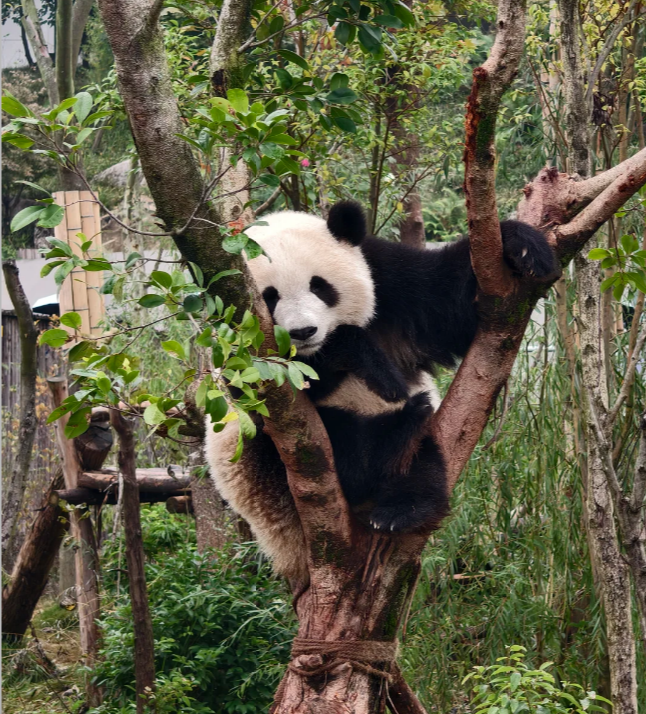
From the bamboo garden, I walked to the Red Panda Enclosure—yes, red pandas are different from giant pandas, and the base has a small group of them. They’re smaller, with reddish-brown fur and bushy tails, and they’re just as cute. One was curled up in a tree, sleeping, while another was climbing from branch to branch, its tail balancing it perfectly. A zookeeper told me that red pandas are also endangered, and that the base works to conserve them too. “People come for the giant pandas,” she said, “but once they see the red pandas, they fall in love with them too. It’s a good way to teach people about all kinds of conservation.”
I spent the afternoon wandering through these hidden parts of the base: a medicinal herb garden where the zookeepers grow plants used to treat sick pandas, a pond where turtles sunbathed on rocks, a small chapel dedicated to the memory of the base’s founding scientists. Each one taught me something new—not just about pandas, but about the people who care for them, the environment they live in, and the work that goes into conservation. It wasn’t glamorous work—cleaning enclosures, preparing food, monitoring health—but it was vital. And everywhere I went, I saw signs of that dedication: a zookeeper sitting with a sick panda, gently feeding it medicine; a group of volunteers planting bamboo; a child dropping a coin into a donation box labeled “Save the Pandas.”
Chapter 4: Dusk at the Base – Goodbyes and Gratitude
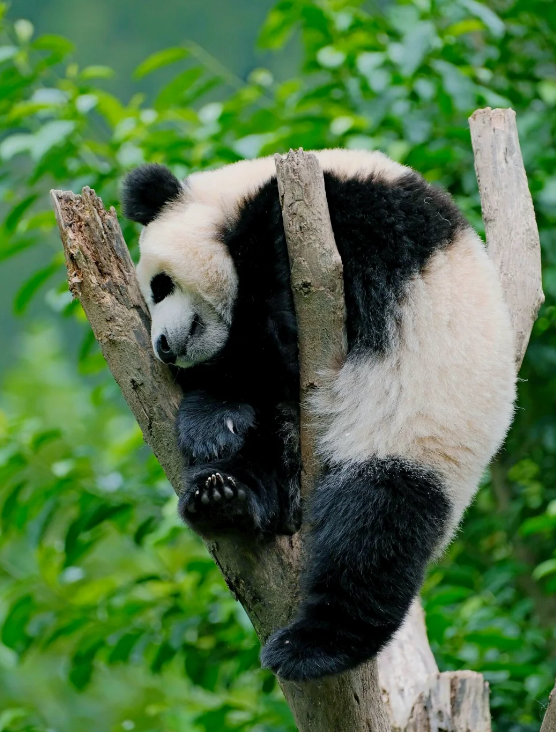
As the sun began to set, painting the sky in shades of pink and orange, I made my way back to the Adult Panda Enclosure. Most of the visitors had left, and the pandas were settling down for the night. The same panda I’d watched eating that morning was now curled up on a wooden platform, its head resting on its paws, fast asleep. Another was lying on its side, snoring softly, its black fur blending into the shadows of the bamboo.
I sat down on a bench near the enclosure, watching them sleep, and thought about the day. I’d come to Chengdu expecting to see cute animals, to take photos, to check a box on my travel list. But what I’d gotten was so much more. I’d seen hope—in the eyes of a panda cub, in the pride of a zookeeper who’d dedicated her life to conservation. I’d seen connection—in the way visitors from all over the world laughed together at a panda’s silly antics, in the way the base worked with scientists from other countries to save a species. I’d seen beauty—not just in the pandas, but in the bamboo forests, the red-crowned cranes, the quiet moments of peace that the base offered.
A zookeeper named Wang, who’d helped me take a photo earlier, walked by and sat down next to me. “You’ve been here all day,” he said, smiling. “Did you get enough pandas?” I laughed and told him I’d never get enough. He nodded. “They have that effect on people,” he said. “People come here, and they see these pandas, and they realize that we can make a difference. That even small things—donating money, recycling, planting a tree—add up.” He pointed to the panda sleeping on the platform. “That’s Da Mao,” he said. “He was born here 15 years ago. Now he’s a father of four. That’s what it’s all about—generations. Making sure that 50 years from now, people can still come here and see pandas like Da Mao.”
As I walked out of the base a little while later, the sky was dark, and the streetlights were coming on. I passed a street vendor selling panda-shaped keychains and stuffed animals, and I bought a small plush panda for my niece. It was a silly souvenir, but it felt like a way to take a piece of the day with me.
That night, as I sat in my hotel room, drinking jasmine tea and looking through my photos, I thought about Jane Goodall’s quote from that morning. “What you do makes a difference.” At the time, I’d thought it was just a nice saying, but now I understood it. The zookeepers at the base, the scientists, the volunteers—they were all making a difference, one bamboo stalk, one panda cub, one day at a time. And in my own small way, by visiting, by learning, by telling people about what I’d seen, I was making a difference too.
I’d gone to the Chengdu Research Base of Giant Panda Breeding to see pandas. But I left with something far more valuable: a renewed sense of hope that we can protect the planet’s most beautiful creatures, that we can work together to build a better future. And every time I look at that plush panda on my shelf, I’ll remember that day—the mist, the bamboo, the sound of a panda crunching on a stalk, and the quiet, powerful truth that hope is alive and well, in the form of a black-and-white bear from Sichuan.