A Day in the Forbidden City: Whispers of China’s Imperial Past
I set my alarm for 5:30 a.m. not out of obligation, but out of greed—greed to see the Forbidden City before the crowds arrived, before the tour groups with their raised flags and loudspeakers filled the courtyards, before the sun climbed high enough to wash out the soft gold of the roof tiles. Beijing’s autumn air bit at my cheeks as I walked from my hotel near Tiananmen Square, the sky still a pale, hazy blue, and when the first glimpse of the Meridian Gate appeared through the morning mist, my breath caught. It wasn’t just a gate—it was a wall of red and gold, towering above me, its eaves curved like the wings of a giant bird, as if ready to take flight with centuries of secrets tucked under its feathers.

I’d read the history, of course: 600 years as the heart of China’s imperial power, home to 24 emperors from the Ming to the Qing dynasties, a place where commoners were forbidden on pain of death. But reading about it is like looking at a postcard of a mountain—you know it’s big, but you don’t feel its weight until you stand at its base. As I handed my ticket to the guard and stepped through the Meridian Gate’s archway, the noise of the street behind me faded, replaced by a hush that felt almost sacred. This was it: the Forbidden City. Not a museum, not a monument, but a place that had breathed with life—with emperors and eunuchs, concubines and scholars, celebrations and sorrows—for centuries.
Chapter 1: Morning Light on Golden Roofs – The First Glimpse of Imperial Splendor
The morning sun was just beginning to warm the stones as I walked into the first courtyard, and I stopped to stare. The Forbidden City isn’t a single building; it’s a city within a city, a maze of courtyards and halls, all aligned perfectly north to south, according to the ancient Chinese principles of feng shui. To my left and right, low-slung buildings with red walls and green tiled roofs lined the path, but my eyes were drawn straight ahead to the Hall of Supreme Harmony—the largest and most important hall in the complex, its roof capped with yellow glazed tiles. Yellow, I remembered, was the color of the emperor, forbidden to anyone else. Even the tiles were a statement of power.
I walked slowly, my shoes clicking on the smooth white marble slabs that covered the ground. The slabs were worn in places, rounded at the edges from millions of footsteps over hundreds of years, and I found myself wondering who had walked here before me. A young emperor, nervous on his first day of ruling? A court lady, hurrying to deliver a message to the empress? A scholar, presenting a scroll of poetry to the emperor for approval? The stones didn’t tell stories, but they held them, in every scratch and curve.
Near the Hall of Supreme Harmony, I paused to examine the marble terrace that the hall sits on. Carved into the stone were dragons and phoenixes, their bodies coiled together, their scales and feathers so detailed I could almost see them moving. A group of workers was gently cleaning the carvings with soft brushes, and one of them noticed me staring. He smiled and gestured to the dragons. “Emperor’s power,” he said in simple English. “Dragons protect him.” I nodded, and as I reached out to touch the cool stone (carefully—signs warned against it, but I couldn’t resist the urge), I felt a shiver. This wasn’t just art; it was a symbol, a way for the emperor to show the world that he was chosen by heaven, protected by mythical creatures.
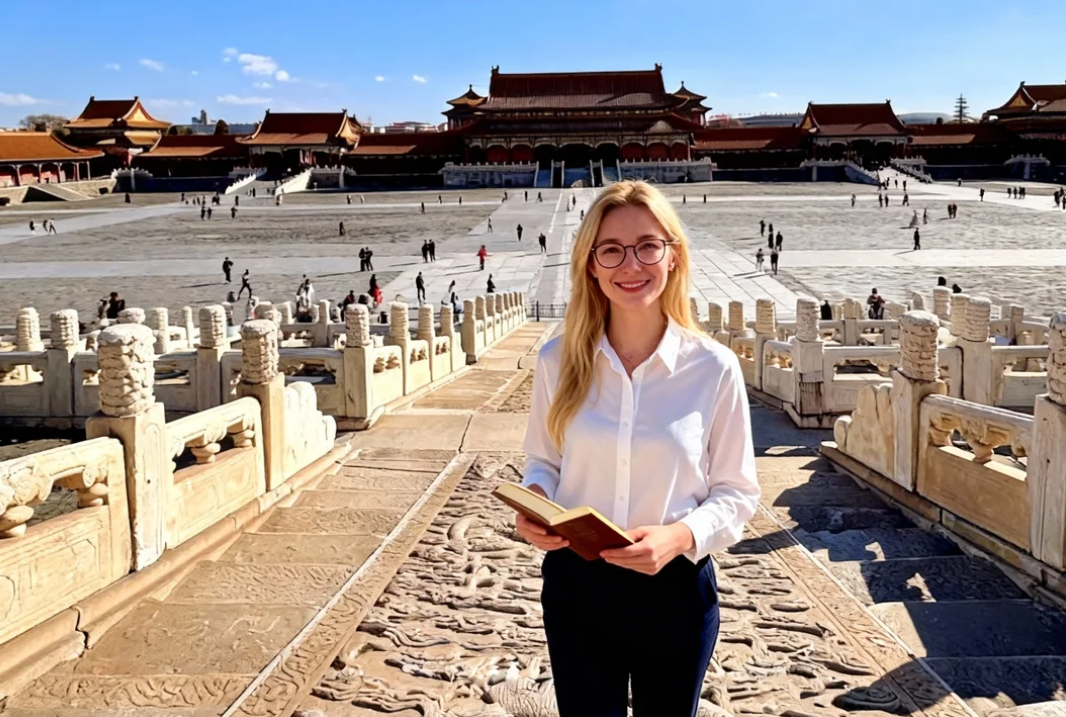
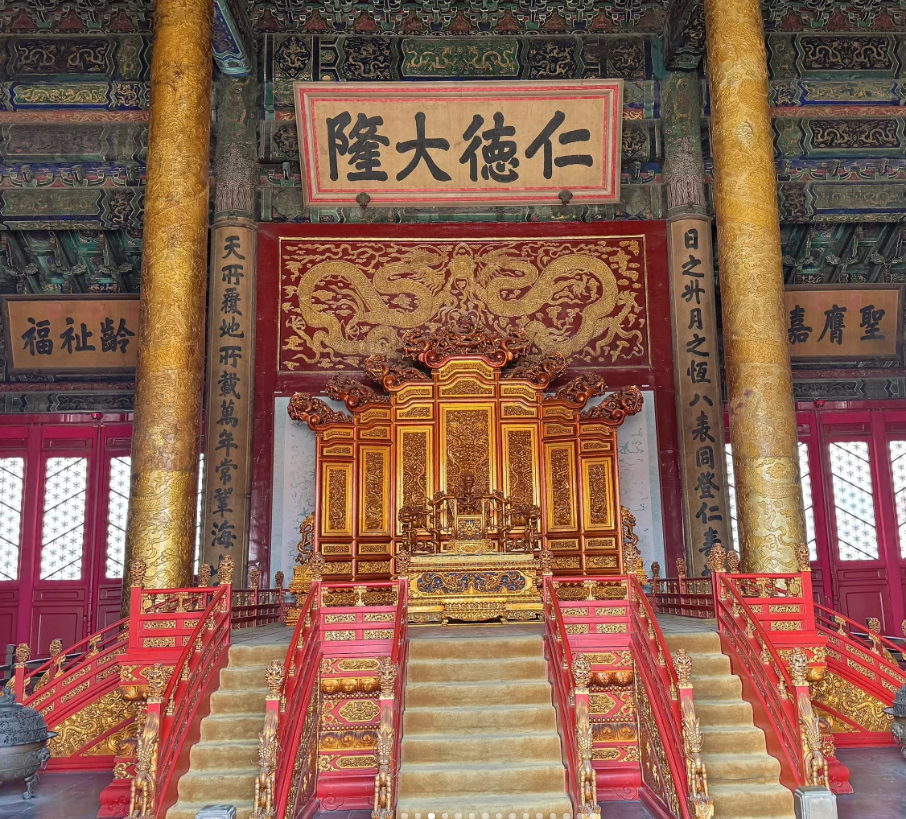
The Hall of Supreme Harmony itself was even more impressive up close. Its doors were open, and I stepped inside, my eyes adjusting to the dim light. The ceiling soared high above me, painted with a giant dragon swirling in clouds, holding a pearl in its claws—the “Dragon of Heaven,” I’d read. In the center of the hall, on a raised platform, sat the Dragon Throne, carved from sandalwood and inlaid with gold and jade. It looked smaller than I expected, not the grand, imposing chair I’d seen in movies, but there was a quiet authority to it. I stood there for a long time, watching as the first rays of sun streamed through the windows and hit the throne, turning the gold inlays into tiny stars. For a moment, I could almost hear the rustle of silk robes, the murmur of courtiers, the emperor’s voice echoing through the hall.
By 9 a.m., the crowds were starting to trickle in—small groups at first, then larger ones, their voices rising to fill the courtyard. I decided to head to the eastern side of the complex, where I’d read there were fewer tourists. As I walked along a narrow path between two red walls, I heard the sound of music—a erhu, its tone high and mournful, drifting through the air. I followed the sound and found an elderly man sitting on a stone bench, playing for no one in particular, his eyes closed, his fingers moving quickly over the strings. The music fit the place perfectly, soft and ancient, as if it had been written for the red walls and golden roofs. I sat down on a nearby bench and listened until he finished, then clapped. He opened his eyes and smiled, a wide, warm smile that crinkled the corners of his eyes. “For the emperor,” he said, gesturing to the hall behind us. “For the past.”
Chapter 2: Courtyards and Secrets – The Human Side of the Forbidden City
By noon, the sun was high, and I was hungry. I’d packed a small lunch—some jianbing I’d bought from a street vendor near my hotel, a bottle of green tea—and I found a quiet spot in the Palace of Heavenly Purity’s courtyard to eat. The Palace of Heavenly Purity was where the emperors lived during the Ming Dynasty, and later became the place where they held their funerals. It was quieter here than in the main courtyards, and I sat on a stone step, watching a family of sparrows hop around my feet, looking for crumbs.
As I ate, I noticed a woman standing near the palace doors, holding a book and staring at the building. She looked like a local, not a tourist—she was wearing comfortable shoes and a simple jacket, and she wasn’t taking photos, just looking. I finished my lunch and walked over to her. “Do you know a lot about this place?” I asked. She turned to me and smiled. “My grandmother used to work here,” she said. “Before it was a museum, she was a cleaner. She told me stories about the palaces at night—how quiet it was, how the wind sounded different here, like it was talking.”
Her name was Lin, and she said she came to the Forbidden City every month, just to walk around. “Most people come for the big halls, the Dragon Throne,” she said, gesturing toward the Hall of Supreme Harmony. “But the interesting things are the small places—the gardens, the side rooms, the corners where no one looks.” She offered to show me her favorite spot, and I agreed. We walked through a narrow archway I hadn’t noticed before, and suddenly we were in a small garden, hidden between two palaces. There was a pond with lotus flowers (even in autumn, a few were still blooming), a stone bridge, and a tiny pavilion with a wooden bench. “My grandmother used to eat her lunch here,” Lin said. “She said the emperors’ concubines would come here to escape the court, to read or just sit quietly.”
We sat on the bench for a while, watching a butterfly flutter over the lotus leaves. Lin told me stories her grandmother had told her: about how the concubines would put flowers in their hair to attract the emperor’s attention, about how the eunuchs would sneak snacks to the palace maids, about how one winter, the pond froze solid, and the emperor’s children had skated on it. For the first time, the Forbidden City felt less like a collection of old buildings and more like a home—a place where people had laughed and cried, loved and fought, just like anywhere else. The emperors and concubines weren’t just names in a history book; they were people, with hopes and fears and small, ordinary moments.
After Lin left to meet her daughter, I explored the side rooms she’d mentioned. One of them was a display of imperial clothing—silk robes embroidered with dragons and phoenixes, shoes with high platforms (for the concubines, Lin had said, to make them look taller), hats decorated with pearls and feathers. The robes were bright and colorful, but what caught my eye was a small, plain blue dress, tucked in the corner of the display. The sign said it was a palace maid’s dress from the late Qing Dynasty. It was made of simple cotton, no embroidery, no decorations—just a plain dress. I stared at it for a long time. The Forbidden City was all about grandeur, about showing off power, but this dress was a reminder of the thousands of ordinary people who had lived and worked here, invisible to history, their stories untold.
In the afternoon, I visited the Hall of Clocks and Watches, a small museum on the western side of the complex. It was filled with clocks from the 18th and 19th centuries, gifts from European kings and merchants to the Qing emperors. Some of them were enormous, with towers and moving figures that played music every hour; others were small and delicate, fit in the palm of a hand. A guide was explaining one of the largest clocks to a group of tourists—how it had been shipped from England to China in pieces, how it took six months to assemble, how the emperor had been fascinated by it because it measured time in a way he’d never seen before.
As I listened, I thought about how the Forbidden City had always been a place of connection and conflict between China and the rest of the world. The emperors had once thought of China as the “Middle Kingdom,” separate from and superior to other nations, but they couldn’t ignore the outside world forever. The clocks were a symbol of that—of new ideas coming in, of old ways changing. It made me think of Beijing today, a city that’s both ancient and modern, where skyscrapers tower over hutongs, and where you can buy a latte next to a street vendor selling baozi. The Forbidden City wasn’t just a relic of the past; it was a mirror, reflecting how China had always been shaped by its interactions with the world.
Chapter 3: Dusk Over the Palace – Saying Goodbye to the Past
By late afternoon, my feet were sore, and my camera roll was full of photos, but I didn’t want to leave. The crowds had thinned out—most tourists were heading to the exit, eager to beat the rush—and the sun was setting, casting a warm orange glow over the roof tiles. I walked back to the main courtyard, where the Hall of Supreme Harmony stood, now bathed in golden light. It looked softer now, less imposing, as if the day’s heat had melted away some of its grandeur.
I sat down on the marble steps, next to an old man who was feeding pigeons. He didn’t speak any English, and I didn’t speak any Mandarin, but we sat together in silence, watching the pigeons circle above the hall. Every now and then, he’d offer me a handful of birdseed, and I’d toss it to the pigeons, laughing as they fluttered around my feet. It was a small, quiet moment, but it felt like the perfect way to end the day—sharing a simple pleasure with a stranger, in a place that had seen so much complexity.
As the sun dipped lower, I walked toward the exit—the Gate of Divine Prowess, the northern gate of the Forbidden City. Before I left, I turned around for one last look. The Forbidden City stretched out behind me, its red walls and golden roofs glowing in the dusk, the courtyards empty now, save for a few stragglers like me. I thought about everything I’d seen that day: the Dragon Throne, the carved marble, the plain blue dress, the small garden with the lotus pond. I thought about Lin’s grandmother, the palace maid, and the emperor who had sat on the throne, and the elderly man playing the erhu. All of them had been part of this place, had left their marks on it, even if those marks were just a worn stone or a memory.
I’d come to the Forbidden City expecting to see a monument to power, to imperial glory. But what I’d found was something more human. It was a place of contradictions: grand yet intimate, powerful yet fragile, ancient yet alive. It was a place where emperors had ruled over millions, but where a palace maid could find peace in a small garden. It was a place where the past wasn’t just something you looked at—it was something you felt, in the cool stone under your hands, in the quiet of the courtyards at dawn, in the sound of music drifting through the air.
As I walked through the Gate of Divine Prowess and into the street, the noise of Beijing hit me again—cars honking, people talking, music blaring from a nearby shop. But for a moment, I still felt the hush of the Forbidden City, the weight of centuries, the warmth of the afternoon sun on the marble steps. I knew I’d never forget this day. Not because of the grand halls or the famous throne, but because of the small moments—the erhu player, Lin’s stories, the old man feeding pigeons. Those moments had turned the Forbidden City from a landmark into a place, from history into memory.
Later that night, I sat in my hotel room, drinking green tea and looking through my photos. But instead of focusing on the grand shots of the Hall of Supreme Harmony, I found myself staring at a photo I’d taken of the small garden—just a pond, a bridge, a few lotus flowers. It was the least impressive photo I’d taken that day, but it was my favorite. Because it wasn’t just a photo of a garden. It was a photo of a secret, a moment of peace in a place that had seen so much. It was a photo of the Forbidden City as it really was: not just a palace, but a home, a story, a part of China’s soul.
People say that travel changes you, and I never really believed it until that day. The Forbidden City didn’t just show me China’s past; it showed me a side of humanity—the desire for power and the need for peace, the grand gestures and the small moments, the way we all leave our marks on the places we love. As I fell asleep that night, I could still hear the erhu’s music, soft and ancient, drifting through the red walls of the Forbidden City. And I knew that wherever I went next, a part of that day—of that place—would stay with me, forever.